There are some great bits in this webinar by @UNISONinSchools about air quality in schools.
— tern (@1goodtern) May 28, 2025
Did you catch these bits on how clean air can help... https://t.co/Fi1T8P4Xbv pic.twitter.com/xl6Sm2cQMa
Showing posts with label IAQ. Show all posts
Showing posts with label IAQ. Show all posts
Monday, June 2, 2025
There are some great bits in this webinar by @UNISONinSchools about air quality in schools.

Wednesday, May 21, 2025
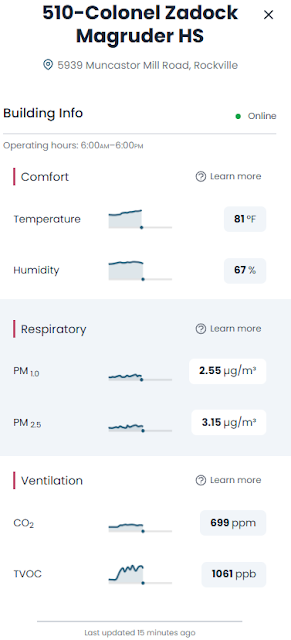
5/16/2025: Magruder HS Closed Early Due to Excessive Heat in Building. Here's what temp and humidity showed.
Magruder High School will be dismissing today, May 16, 2025, at 12:45 pm due to excessive heat in the building. Families, please see the community message that I sent to you for more details.
— Chris Ascienzo (@MHS_principal) May 16, 2025
When Magruder High School was closed on May 16th, the AVERAGE interior temperature was 81 degrees and the AVERAGE humidity for the building was 67% at 12:30 PM.
Superintendent Thomas W. Taylor and the Board of Education pay millions of dollars for the temperature and humidity for every single room in every single school building in Montgomery County Public Schools, but they hide those details from parents and staff. All that is known is that these were the AVERAGES at the time the school was closed.
How hot were the hottest rooms and what was the highest humidity?
12:30 PM averages at Magruder High School:
Thursday, December 12, 2024
UConn Keeping Air in Connecticut Classrooms Safe
Several years of community service and real-world research of the cross-campus UConn Indoor Air Quality Initiative has led to the awarding of $11.5 million in state support to UConn to bring access to low-cost, do-it-yourself “Corsi-Rosenthal” air-purifiers to every individual public school classroom in Connecticut.
On October 22 the State Bond Commission in Connecticut approved funding for the UConn Indoor Air Quality Initiative to administer and implement the purchase of equipment and materials for the construction and installation of individual classroom air purifiers. The state funding awarded to UConn will be part of SAFE-CT: Supplemental Air Filtration for Education Supplemental under the Clean Air Equity Response Program.
“We are pleased to offer these inexpensive devices to all classrooms across Connecticut,” says the Director of the UConn Indoor Air Quality Initiative, Marina Creed, an APRN who also serves UConn Health as a neuroimmunology nurse practitioner. “When schools, students, and teachers run one of these inside their classrooms it will reduce their exposure to viruses and bacteria, reducing the risk of disease transmission, meaning they are less likely to get sick.”
Creed adds, “Thank you to the Governor, Lieutenant Governor, and General Assembly for putting the health of our students and teachers first.”
Although these devices are created simply with just $60 of hardware store materials, they have been shown to be incredibly effective. The EPA and UConn jointly tested the devices in the EPA’s large bioaerosol test chamber, and results showed that in just 60 minutes it effectively removes over 99 percent of airborne viruses including the virus that causes COVID-19. Plus, recently published collaborative research findings by UConn and Arizona State University also show that DIY air purifiers work better than commercial HEPA air cleaners for a fraction of the cost...
https://today.uconn.edu/2024/10/uconn-keeping-air-in-connecticut-classrooms-safe/#
Wednesday, September 4, 2024
Kids Are Headed Back to School. Are They Breathing Clean Air?

Across the U.S., kids are headed back to their classrooms—just as COVID nears a fresh, late-summer peak. Somehow, four years into a viral pandemic that everyone now knows spreads through the air, most schools have done little to nothing to make sure their students will breathe safely.
We—and especially our children—should be able to walk into a store or a gym or a school and assume the air is clean to breathe. Like water from the faucet, regulations should ensure our air is safe.
“Air is tricky. You can choose to not partake of the water or the snacks on the table, but you can’t just abstain from breathing,” notes Gigi Gronvall, senior scholar at the Johns Hopkins Center for Health Security and an author of a 2021 report on the benefits of improving ventilation in schools.
The COVID-causing virus SARS-CoV-2 is far from the only airborne risk in schools. There are also other respiratory viruses, smoke from wildfires, mold spores, off-gassing from plastics and other compounds, air pollution from traffic and industry, and allergens that worsen asthma and add to sick days. Yet federal air standards are stuck in the 1970s, when they were mostly aimed at protecting people from secondhand tobacco smoke, says Joseph Allen, director of the Healthy Buildings Program at the Harvard T. H. Chan School of Public Health. Fully updated standards for buildings are years or even decades away.
It’s hard to assess just what schools have or haven’t done to improve indoor air quality. No one—not one federal agency—collects nationwide air quality data on individual schools. Schools could use federal money to update air filtration and ventilation during the height of the pandemic. But a 2022 Centers for Disease Control and Prevention survey of school districts found that only half had taken simple steps such as opening windows or doors or using fans, and even fewer had upgraded ventilation systems...
Kids Are Headed Back to School. Are They Breathing Clean Air? | Scientific American
Tuesday, June 4, 2024
Breaking: AC Broken at Springbrook HS, Median Temp of School 83 Degrees at 10:20 AM

And then word from students at Springbrook High School that they are in the second day of no air conditioning due to a broken HVAC system.
What's new this year is that MCPS has installed indoor air monitors in EVERY SINGLE CLASSROOM in the entire school system. Parents and guardians can now monitor the indoor air quality of their child's school in real time.
However, MCPS administrators only want parents to have limited information about the indoor air of schools. Therefore, MCPS is only making the median indoor air temperature of the entire building public.
So for each MCPS school building, even though every single room has an indoor air monitor, MCPS only releases one number for the entire building. The number released is the median temperature number for the entire school building.
Today, we know that as of 10:20 AM the median temperature of Springbrook High School is 83 degrees. That's the median temperature. How hot are half of the classrooms in that building right now?
Subscribe to:
Posts (Atom)