Six high schools are set to get either new synthetic turf fields or replacement fields as part of Montgomery County Public Schools (MCPS) proposed six-year capital improvements program (CIP), a plan that sparked debate among county school board members Tuesday over whether the district should move forward with turf or explore installing more natural grass fields.
MCPS Athletics Director Jeffrey Sullivan and Capital Budget and Projects Manager Donald Connelly joined the school board Tuesday to talk about the proposal for fields during a CIP work session at the school board headquarters at 15 W. Gude Drive in Rockville. They discussed the costs, benefits and drawbacks of natural and turf fields as part of the board’s review of the district’s $2.7 billion proposed CIP plan.
In recent weeks, the board has held several work sessions to review the proposed CIP, and is expected to vote on the proposal during its Nov. 20 business meeting.
The CIP calls for the district to spend $15 million during fiscal year 2027 for six turf installations or replacements. The amount also includes money for three or four playground replacements...
What’s the hottest summertime spot in Montgomery County?
A group of citizen scientists will soon find out.
Montgomery County is undertaking a project to map out various temperatures of its neighborhoods as a part of a national effort to keep track of heat inequities and find solutions for the county’s urban heat islands...
Of the 32 teams in the NFL, 16 teams still play on artificial turf, despite the undeniable risk it poses to both players and the environment. It’s time to play smarter with Pennington.
The numbers don’t lie:
28% more non-contact lower body injuries.*
32% more non-contact knee injuries.*
And 69% more non-contact foot and ankle injuries occurred on turf.*
Turf can get up to 60 degrees hotter than natural grass, increasing the rate at which toxic gases are released and ingested.**
90% of NFL players believe artificial turf will shorten their careers.***
And the issue is bigger than just football.
Currently, turf can’t be recycled in the US, leading to an estimated 330 million pounds of landfill waste each year, and microplastics in our water and irrigation systems.****
On average, one turf field requires over 440,000 pounds of petroleum derivatives. The production of which emits carbon, creates fossil fuels, and contributes to global warming. ****
Unlike grass, turf does not cool the environment. It does not filter air and water pollutants. It does not fix carbon dioxide or release oxygen. Turf has zero climate benefits.*****
As pioneers of the grass industry, Pennington believes in working with nature, not against it. That’s why we’re rallying for change.
Every signature we get applies pressure to the NFL and its team owners to face the facts and make the flip to a more sustainable field. If they say yes, we’ll bring the grass— no questions asked. And we won’t stop pushing until all 32 NFL teams ditch the turf. Because every game the NFL allows to play out on turf actively puts their own players at risk. And in turn, our planet.
Sign this petition to join the movement to #FlipTheTurf.
*Based on NFL injury data collected from 2012 to 2018
**Based on 2007 Columbia University study in New York City
***Based on 2010 NFLPA Survey
****Based on 2017 Synthetic Turf Council data detailing an average 440,000 lbs of turf and infill per sports field and an estimated 750 fields being replaced in 2018
*****The University of Arkansas, “Turfgrass Science” Study, 2009
MSI Soccer put in this field, who is on the hook to make required repairs? Will the warranty cover what is needed to make the field usable again? What is the mystery infill that MCPS now claims has "exceptional results?"
On Thursday, February 10, 2022, 4:36 PM, Robert Dodd wrote:
Dear Walt Whitman High School Community Members,
This message was developed in collaboration with the MCPS Division of Construction. The purpose of this message is to provide our community with both an update on the repair of the Walt Whitman High School (WHHS) artificial turf field and an outline on the reopening of the field.
As many are aware, the WWHS artificial turf field system consists of multiple components, which include organic infill, the artificial field carpet, and an underdrainage system. Over the past three years, MCPS has maintained the artificial field consistent with warranty requirements. A link to the Artificial Turf Fields Program and artificial turf maintenance logs can be accessed at: https://www2.montgomeryschoolsmd.org/departments/athletics/programs/default/542923/
Even with the required maintenance over the last three years, the turf system has failed and is not draining at the rate required to make the surface playable after a rain event. MCPS is pursuing this failure as a condition of warranty and is coordinating with the contractor and manufacturer to make appropriate repairs to restore the field to full compliance. The approach to repairing the field will include removing the original organic infill and sand mixture and utilizing a newer organic infill that MCPS has recently been installing. MCPS has found that this new infill has produced exceptional results.
The timeline of these repairs is contingent on the availability of specialized equipment as well as securing the infill material. Once the work begins, we anticipate a 3 to 4 week period to make the appropriate repairs. The timing of this work will compromise the beginning of spring sports. That said, our goal continues to be to have the turf field open as soon as possible during the spring season. MCPS Athletics is working with us to ensure that our student-athletes are impacted to the minimal amount possible as this work occurs. We will share specific changes to practice and contest locations and schedules within the next week.
We appreciate the patience and understanding of the Whitman community and look forward to reopening the field, once the necessary repairs have been completed. We will keep you updated once the repairs have begun. Thank you for your continued support.
This high school had the same type of plastic football field as is currently in use at Walter Johnson High School. The WJHS plastic field has been deteriorating for years due to the defective plastic grass blades. MCPS and the Board of Education have ignored the failure of this field and continued to keep in open, putting the safety of children at risk every day.
You’re invited to a Community Forum Monday, July 29 at 7 pm!
Recent media reports have shown dangerously high lead levels on DC-area playgrounds and playing fields made from synthetic materials, such as shredded tires. These playgrounds and fields can be dangerously hot, dangerously hard, and made with no fewer than 13 carcinogens. Recent testing shows high levels of lead at several local school playgrounds, including Takoma, Truesdell, and Janney.
Join us for a panel discussion and Q & A on Monday, July 29 at 7 pm with Dr. Alexander Wooten from Morgan State University, Dr. Diana Zuckerman from the National Center for Health Research, and Dr. Jeff Gearhart from the Ecology Center. Details and registration here.
This forum promises to be an enlightening and thought-provoking discussion of importance to the media as well as parents, grandparents, policy makers, and people who care about our environment.
In addition to a broad overview, the panel will answer specific questions regarding the Ecology Center’s recent findings of high lead on the playgrounds at Takoma, Truesdell, and Janney.
The National Center for Health Research is a nonprofit think tank that has scientifically analyzed the evidence regarding artificial turf and playgrounds, and testified before the U.S. Consumer Product Safety Commission, DC legislators, Maryland legislators, and Connecticut legislators. To learn more, check out our website at www.center4research.org and write “tire” in the search box, to see some of the articles and letters we’ve written on the topic.
The Parents' Coalition has learned that the brand new Richard Montgomery High School artificial turf field was closed in November due to "dangerous-turf" issues.
The Richard Montgomery High School (RMHS) replacement artificial turf field opened on August 24, 2018, and by the end of November the field was closed for "dangerous-turf" issues. For those following the many issues surrounding the replacement of this plastic field the "dangerous-turf" issues come as no surprise.
To date, we have documented the following issues surrounding the replacement of the RMHS artificial turf field:
If the RMHS artificial turf replacement field is state of the art and would not harm students, why was the field closed in November, three months after installation?
The Parents' Coalition obtained e-mails and documents from Montgomery Parks concerning their decision in 2016 to replace the Montgomery Blair High School artificial turf football field.
In the e-mail below was a discussion of the choice of contractor, choice of plastic carpet, and choice of infill for the new Blair High School artificial turf football field. As part of the evaluation of these different products, the Somerset Elementary School artificial turf field was evaluated and discussed.
From this e-mail, we learn that the Somerset Elementary School artificial turf field requires daily maintenance by MCPS staff and that Montgomery Parks had determined that the infill used at Somerset was not a "viable product."
How many MCPS elementary school fields have staff brushing the field on a daily basis? Who is paying for the increased maintenance costs of this plastic field?
The e-mail contains a lot of additional information about how artificial turf fields are purchased in Montgomery County and how the fields are performing and annual costs associated with these fields. None of this information is ever discussed by the Board of Education.
There is also a RMHS storm drain completely clogged with crumb rubber showing that the "filters" that Superintendent Jack R. Smith and MCPS COO Andrew Zuckerman have said were keeping the crumb rubber out of the Cabin John Watershed had completely failed.
Note that the day before these pictures were taken, August 2nd, the storm drains around RMHS were inspected (See page 7 of document) after a heavy rain by the Maryland Department of Environment (MDE). The inspection did not find crumb rubber in the system outfall, but noted that MDE would be back at a later date to inspect the "staging area" when the contractor "demobilizes" from the site. The "staging area" is shown in the pictures below. Apparently, MDE does not inspect "staging areas," even one's that are actively polluting a watershed.
Sand delivery for new artificial turf field.
Crumb rubber tire tracks are still seen
all over the RMHS property.
See Parade of Pollution posts documenting the pollution to our stormwater and environment from the removal of this one artificial turf football field at this link.
Part 8:
At the July 30, 2018, Montgomery County Board of Education meeting Superintendent Jack R. Smith had MCPS Chief Operating Officer Andrew Zuckerman read a prepared statement about the removal of the artificial turf at Richard Montgomery High School. In the statement, Superintendent Smith called the discussion around the removal of the artificial turf a "distraction from core mission."
The statement read in part:
...It is unfortunate that there is a small group of individuals attempting to mislead and misinform our community about this issue. This behavior distracts from our core mission of teaching and learning. I am particularly troubled by the fact that in this case we are fielding questions about a paintball facility’s reuse of artificial turf in White Marsh, Maryland when here in Montgomery County locally we are focused on creating opportunities for all students to learn and achieve at high levels...
Unbeknownst to Superintendent Smith and MCPS COO Andrew Zuckerman an individual had traveled to the White Marsh, MD location that Smith and Zuckerman were claiming was an artificial turf recycling facilty. That person posted their pictures of what they found to Facebook and Twitter.
Does this look like a "storage facility" to you? Does it look like anything other than a paint ball field with used artificial turf and crumb rubber dumped all over it?
From Twitter:
My hope is that MCPS does better the next time they dispose of artificial turf and infill. Does this seem like environmentally responsible move? pic.twitter.com/s4lZKzXTVg
See Parade of Pollution posts documenting the pollution to our stormwater and environment from the removal of this one artificial turf football field at this link.
These pictures were taken on July 29, 2018, and document that tons of plastic grass and crumb rubber were still on site at Richard Montgomery High School 8 days after the MCPS Chief Operating Officer wrote that the field had been removed. Each dumpster holds approximately 4 tons of material, so here is another 4 tons of plastic grass and crumb rubber that were not loaded on a "flatbed trailer for transport" as Superintendent Jack R. Smith wrote in his August 8th memorandum to the Board of Education. This is the 3rd dumpster full of plastic grass and crumb rubber that we photographed on site. These pictures also show that on July 29th loose crumb rubber was still on the ground at RMHS and was not being contained or prevented from entering the Cabin John Watershed. Crumb rubber was leaking from the dumpster and entering the storm drain. The filters that MCPS attempted to use were not effective.
See Parade of Pollution posts documenting the pollution to our stormwater and environment from the removal of this one artificial turf football field at this link.
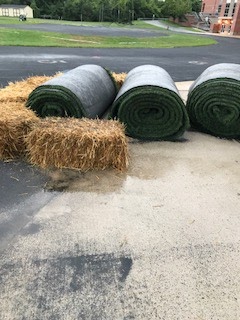
Part 6: These pictures were also taken on July 26, 2018, and document the removal of the football field of plastic grass and 120 tons of crumb rubber from Richard Montgomery High School. These pictures show the rolls of artificial turf and crumb rubber that wereleft behindat RMHS after the tractor trailer load was taken away. These pictures also show INSIDE one of the dumpsters at Richard Montgomery High School. Inside the dumpster is loose crumb rubber, hay, plastic bottles, and wads of plastic grass. Contrast this picture with what Superintendent Jack R. Smith told the Board of Education about the removal of the artificial turf field in his August 8th memo.
The picture below clearly shows hay, plastic bottles, loose crumb rubber and plastic grass randomly tossed in a dumpster. The contents of this dumpster were not rolled up and were not going to be reused or repurposed. This dumpster was on its way to a landfill in Brunswick, Virginia.
On July 26th, rolls of artificial turf with crumb rubber spillling out are still at Richard Montgomery High School.
See Parade of Pollution posts documenting the pollution to our stormwater and environment from the removal of this one artificial turf football field at this link.
Part 5: Then the rain came. On July 21, 2018, Rockville received 5.39 inches of rain in one day. That same day, MCPS Chief Operating Officer Andrew Zuckerman sent out a letter to the public.
July 21, 2018Dear MCPS Community,This week, contractors began work to replace the artificial turf field at Richard Montgomery High School. The existing artificial turf material has been removed and sent for recycling. The entire system, including turf fibers and infill, will be repurposed as a continuation of the overall lifecycle of the materials.In addition, any remaining debris left over from the removal of the turf field will be cleared. We have taken steps to mitigate the impact of the field removal process on the surrounding environment. In addition to sweeping up debris, the storm water management system under the surface at Richard Montgomery High School is designed to contain debris within the system to allow for thorough, periodic cleaning. Other preventative measures, such as the use of mesh screening over turf materials waiting to be hauled away, are also in place. Contractors and MCPS staff are working diligently to remove the artificial turf in a safe and efficient manner and look forward to installing the new organic infill field shortly. Andrew ZuckermanChief Operating OfficerMontgomery County Public Schools
The pictures below were taken onJuly 24, 2018at Richard Montgomery High School and contradict the statements made by the MCPS COO.
The existing artificial turf and crumb rubber had not all been removed by July 21st.
Mesh screening is not in use over the artificial turf left on site.
Crumb rubber can be seen clogging up a storm drain, leaking out of a dumpster and spilling out of rolls of used artificial turf.
Crumb rubber can be seen floating in puddles of water on the grass.
The removal of the used artificial turf and 120 tons of crumb rubber was far from over 3 days after the letter from the MCPS COO on July 21st.
See Parade of Pollution posts documenting the pollution to our stormwater and environment from the removal of this one artificial turf football field at this link.
July 18th RMHS: Unprotected storm drain clogged with crumb rubber and water.
Superintendent Jack R. Smith wrote a memorandum to the Board of Education on August 8, 2018, disputing what is clearly shown in photographs from Richard Montgomery High School in our series of photographs over multiple days. See Parade of Pollution posts.
As our pictures show, some of the rolls of plastic grass and crumb rubber left the RMHS site on the back of an uncovered tractor trailer on a bright sunny day. Superintendent Jack Smith's excuse for why the tractor trailer left RMHS uncovered with crumb rubber spilling out into the road does not correspond with reality.
Superintendent Smith refers to a company by the name of TurfCycle, but does not address the fact that such a company is not licensed to do business in Maryland and does not exist anywhere on the Internet. Superintendent Smith contracted with this company and that begs the question, on what basis does MCPS evaluate the existence and licensing of its contractors?
Superintendent Smith does not explain what happened to the 35+ rolls of plastic grass and crumb rubber that were not removed from RMHS by TurfCycle. Where did those 12+ tons of plastic and ground up tires go?
Finally, Superintendent Smith cites a funding source for the replacement of the RMHS artificial turf football field that does not exist. The Artificial Turf Program Fund was appropriated by the Montgomery County Council to pay for the installation of new artificial turf fields at high schools that did not have an artificial turf field. The Fund was not created to pay for the replacement of artificial turf fields.