Showing posts with label Corsi-Rosenthal box fans. Show all posts

Thursday, December 12, 2024

UConn Keeping Air in Connecticut Classrooms Safe

 UConn Today

Several years of community service and real-world research of the cross-campus UConn Indoor Air Quality Initiative has led to the awarding of $11.5 million in state support to UConn to bring access to low-cost, do-it-yourself “Corsi-Rosenthal” air-purifiers to every individual public school classroom in Connecticut.

On October 22 the State Bond Commission in Connecticut approved funding for the UConn Indoor Air Quality Initiative to administer and implement the purchase of equipment and materials for the construction and installation of individual classroom air purifiers. The state funding awarded to UConn will be part of SAFE-CT: Supplemental Air Filtration for Education Supplemental under the Clean Air Equity Response Program.

“We are pleased to offer these inexpensive devices to all classrooms across Connecticut,” says the Director of the UConn Indoor Air Quality Initiative, Marina Creed, an APRN who also serves UConn Health as a neuroimmunology nurse practitioner.  “When schools, students, and teachers run one of these inside their classrooms it will reduce their exposure to viruses and bacteria, reducing the risk of disease transmission, meaning they are less likely to get sick.”

Creed adds, “Thank you to the Governor, Lieutenant Governor, and General Assembly for putting the health of our students and teachers first.”

Although these devices are created simply with just $60 of hardware store materials, they have been shown to be incredibly effective.  The EPA and UConn jointly tested the devices in the EPA’s large bioaerosol test chamber, and results showed that in just 60 minutes it effectively removes over 99 percent of airborne viruses including the virus that causes COVID-19. Plus, recently published collaborative research findings by UConn and Arizona State University also show that DIY air purifiers work better than commercial HEPA air cleaners for a fraction of the cost...


https://today.uconn.edu/2024/10/uconn-keeping-air-in-connecticut-classrooms-safe/#

Tuesday, October 31, 2023

EPA Testing Shows the Power of D-I-Y Air Filters to Trap Viruses

The results are in: U.S. Environmental Protection Agency research testing of do-it-yourself ‘Corsi-Rosenthal Box’ indoor air filters shows they are 99% effective in removing airborne virus. The 'Owl Force One' device tested by the EPA was built by UConn Indoor Air Quality Initiative researchers with Middletown, Connecticut public school children.

There is a low-cost way for you to protect yourself and reduce your risk of respiratory diseases such as flu, RSV, and COVID-19. Build yourself a Corsi-Rosenthal box (CR box) in 30 minutes with just $60 worth of common hardware store supplies.

In July, U.S. Environmental Protection Agency scientists began several weeks of advanced bioaerosol chamber testing to assess the efficacy and power of this air filter against infectious aerosols, like the virus that causes COVID-19. The results are in, and they are good.

The U.S. EPA Office of Research and Development’s 3,000 cubic ft. bioaerosol chamber testing results show that the CR box removes 97% of infectious aerosols in just 30 minutes, and 99.4% within 60 minutes. Importantly, the device successfully captures a surrogate virus for SARS-CoV-2, the virus that causes COVID-19.

A team of EPA scientists led by Katherine Ratliff conducted the bioaerosol chamber testing of the CR box after testing more expensive air cleaning technologies throughout the pandemic.

“The study results are extremely exciting,” says EPA’s Ratliff. “These CR boxes really work. The Corsi-Rosenthal box works against infectious aerosols in the air. The results are really powerful. Three different sets of biochamber testing data show that these air filters reduce the amount of infectious virus in the air and capture both smaller and larger sized particles. CR boxes are more effective at reducing concentrations of infectious aerosols in indoor air than some of the more expensive technologies that we tested.”

“These scientific results are huge!” says Marina Creed, APRN, director of the UConn Indoor Air Quality Initiative. “These inexpensive, do-it-yourself air filters are for everyone. If you put this in your home, it will remove infectious germs that cause disease from the air. Schools, students, and teachers if you run one of these inside your classrooms it can reduce your exposure to viruses and bacteria, reducing the risk of disease transmission, meaning you are less likely to get sick.”..

EPA Testing Shows the Power of D-I-Y Air Filters to Trap Viruses - UConn Today

Friday, October 20, 2023

Inexpensive, do-it-yourself air cleaner that can be easily constructed out of a box fan and MERV-13 furnace filters.

 The Corsi-Rosenthal Cube (sometimes called a Comparetto Cube) is an inexpensive, do-it-yourself air cleaner that can be easily constructed out of a box fan and MERV-13 furnace filters. The Corsi-Rosenthal Cube can give whole-room air cleaning performance comparable to commercial HEPA air cleaners that are 10x or more the cost. Total cost is around $100USD ($130CAD)...

Corsi-Rosenthal Cube - Encycla

Saturday, March 25, 2023

Illinois Department of Public Health Launches $30 Million Program to Distribute Air Purifiers in Illinois Schools - 60,000 HEPA (High Efficiency Particulate Air) purifiers to Illinois schools to help reduce the transmission of respiratory viruses, including COVID-19.

IDPH Launches $30 Million Program to Distribute Air Purifiers in Illinois Schools

Press Release - Thursday, March 16, 2023

CHICAGO - Governor JB Pritzker and the Illinois Department of Public Health (IDPH) announced today that the state is launching a $29.6 million program to distribute more than 60,000 HEPA (High Efficiency Particulate Air) purifiers to Illinois schools to help reduce the transmission of respiratory viruses, including COVID-19.

IDPH is coordinating the program with the Illinois State Board of Education (ISBE). The program is funded by the CDC through the American Rescue Plan Act of 2021 and is targeted for school districts that serve lower income communities and counties that have elevated air pollution counts. IDPH estimates almost 3,000 schools will be eligible for the program, covering 68 percent of school districts in the state. It will cover schools throughout the state, including Cook County, with the exception of Chicago, which has received a separate federal grant.

"There is nothing more important to me than keeping Illinoisans safe and healthy—especially when it comes to our youth," said Governor JB Pritzker. "We know that our children need to stay healthy and study in classrooms that are well-ventilated in order to thrive and succeed. Thanks to this $30 million investment, schoolchildren will experience cleaner air—preventing illness and absenteeism, while improving our children's ability to think and learn."

"I have devoted much of my career to protecting and promoting the health of children," said IDPH Director Dr. Sameer Vohra, who is a pediatrician. "Data over these last three years have shown us the critical importance of good ventilation to keep children and adults safe from respiratory illnesses. These HEPA air purifiers are a significant investment in our children, and I am very excited that the State of Illinois can make this impact. They will keep kids healthy and in school, ensuring more opportunities for learning and success for years to come."

"Every Illinois student deserves a safe, healthy learning environment regardless of zip code or income level," said State Superintendent of Education Dr. Tony Sanders. "Improving classroom ventilation with air purifiers is a proven method we can use to reduce the transmission of respiratory viruses, including COVID-19, the flu, and RSV, and, at the same time, reduce absences related to illness. A child's health and attendance is inextricably tied to their ability to learn, and I'm pleased the State is making this vital investment."

IDPH is launching an enrollment process in coordination with ISBE through which schools can submit orders for portable HEPA air purifiers. The administrators of eligible school districts will be contacted directly with information about how many purifiers that their districts are eligible to receive. The portable air purifiers will be delivered to school districts in the coming months. Schools will generally be eligible for one small air filter unit for each 20 students in a school, with a limited number of larger units for districts with more than 1,000 students.

Questions from school administrators should be directed to the IDPH Air Purifier Project Inbox at DPH.AirPurify@illinois.gov.

Studies show that cleaner air can reduce absentee rates, and improve students' abilities to think, learn, read and solve math problems.

Last year IDPH issued ventilation guidance to educate the community on the impact of ventilation systems and to provide information about low cost and DIY interventions for ventilation upgrades.

Wednesday, September 28, 2022

Are you looking for a quick and easy was to explain the steps necessary for safer indoor environments? Here it is.

Monday, September 26, 2022

Excellent chart giving pros and cons of different air cleaning techniques. This should be distributed to every school administration so that they can adequately assess what they are purchasing.

Friday, September 16, 2022

A DIY air purifier that costs under $100 to make is taking America’s classrooms by storm [But not @mcps @mocoboe !!!]

Late last year, Shiven Taneja was a person in search of a solution. His community of Mississauga, in Ontario, was entering its fifth COVID wave and Omicron was a fearsome, fast-spreading variant–yet rapid tests were in short supply and the availability of booster shots severely limited. He wanted a way to reduce risk.

Taneja found a potential answer in the same place many of us look: online. Reading about a do-it-yourself air filtration system designed to reduce aerosol particulates, he realized he could construct such a model for his own home at a fraction of the cost of a commercial HEPA purifier. Taneja quickly offered to build similar systems for others in his community at cost–and the requests came pouring in. A DIY solution to filtering the air had suddenly grown legs.

“My family’s living room became a warehouse for storing filters and fans,” Taneja told me. Since December, he says, he has delivered scores of home-built filtration systems, primarily to seniors and the immunocompromised who might not be able to do so for themselves.

All this would be impressive under any circumstance. It’s slightly more so when you consider that Taneja is 15 years old. And as we move into what may well be the endemic phase of Covid, his solution is one that many others around the world are also finding...

A DIY air purifier that costs under $100 to make is taking America’s classrooms by storm | Fortune

Thursday, September 8, 2022

Sure @MCPS this is all fine and dandy hand waving but where is the real commitment to air quality and monitoring, ventilation, and filtration?


 ~~~~~~~~~~~~~~~~~~~~~~~~~~~~

IMPORTANT MESSAGE FROM THE MCPS SCHOOL SYSTEM MEDICAL OFFICER

Dear MCPS Community,

We are so excited to be back together next week for the new school year! As we return to shared spaces, the health and wellness of our students and staff remains a top priority. We have more tools, experience and knowledge than ever to help reduce the impact of COVID-19 in our school community. Here are some important things to know about vaccination, testing and masking as staff and students return to school:  

COVID-19 Vaccination Helps Our School Community

Vaccines are an important way to lower individual risk of severe complications from COVID-19 infection. A high vaccine coverage rate helps reduce the overall burden of COVID-19 on the school community and helps keep learning going, as individuals with milder symptoms will miss fewer school or work days. We continue to strongly recommend students receive all recommended COVID-19 vaccines and boosters for which they are eligible. At this time, COVID-19 vaccination is required for staff unless approved for a medical exemption. We will continue to provide opportunities for students, staff and family members to receive COVID-19 vaccines at after-school and weekend events.

Rapid Testing for COVID-19 for a Strong School Year Start

Montgomery County Public Schools (MCPS) is encouraging at-home rapid testing for COVID-19 as staff and students return to school. Testing is an important way to identify individuals actively positive for COVID-19 who should temporarily isolate in order to prevent further transmission and keep our school community as healthy as possible.  

End-of-summer activities, such as returning from travel or getting together with larger groups, can increase the risk of exposure to COVID-19. Staff and students may consider testing even after school begins, following Labor Day holiday travel or after higher-risk social events that may coincide with the start of the school year. Testing is not mandatory. We are depending on our staff and families to consider their exposure risk, and test and report positive results accordingly. 

Test kits will be available at schools, at the MCPS Annual Back-to-School Fair on Aug. 27, and upcoming school-based weekend vaccination clinics on Aug. 27 and Aug. 28. Free rapid test kits are also available to Montgomery County residents at most public library locations, or by mail for home delivery from the U.S. government. Only positive test results need to be reported using the MCPS COVID-19 Reporting Form. Individuals who have a positive COVID-19 test should report their positive result and follow CDC guidelines for isolation

Masking 

As of today, the CDC COVID-19 Community Risk Level for Montgomery County is “low.”  At this time, masking is not mandatory in MCPS buildings or buses in most situations. Health room staff actively engaged in patient care or anyone assisting with medical procedures must follow infection control guidelines from the DHHS and the CDC, including wearing a mask when required.   

In addition, masking may be temporarily required for individuals or groups, in certain circumstances:

  • A student develops symptoms of COVID-19 during the school day and presents to the health room for evaluation
  • A student has tested positive at school for COVID-19 and is awaiting pick-up
  • In outbreak situations, as an alternative to quarantine for exposed individuals who do not have symptoms of COVID-19
  • For students or staff recovering from COVID-19 who have completed at least five full days of isolation, and feel well enough to return to school or work. 

Recommendations and requirements for masking can be expected to change during the school year, as COVID-19 data trends and science change. For individuals who cannot safely mask, other prevention measures will be used. 

Please remember that all staff and students are supported in their decision to wear a mask for individual protection, at any risk level.  MCPS will continue to provide masks for staff and students for use during the school day.

The new school year is just around the corner! Let’s work together to keep our school community well, as we return with excitement, renewed purpose and joy.  

Sincerely,

Patricia Kapunan, M.D.
MCPS Medical Officer

Monday, September 5, 2022

How to build Corsi-Rosenthal Box to protect against COVID for under $100 #COVIDisAirborne

Life in many places has largely returned to a pre-pandemic normal. People are tired of masking and remaining socially distant, even though contagious COVID-19 variants show no signs of going away anytime soon.

With attitudes toward COVID-19 becoming increasingly lackadaisical, public health experts are touting ventilation as a less-intrusive way to stop tiny particles carrying the virus from traveling through the air. But uptake of better ventilation practices — which can range from expensive to unrealistic — has been slow.

Enter the Corsi-Rosenthal Box, a do-it-yourself air filtration system that has taken the internet by storm. Each box typically costs under $100 to make and is more effective than other, pricier options like High Efficiency Particulate Air filters.

The simple contraption consists of a box fan, four MERV13 furnace filters that can be purchased online or in store, some cardboard and strips of tape. It’s the brainchild of air quality researcher Richard Corsi, dean of engineering at the University of California, Davis, and Jim Rosenthal, CEO of Texas-based company Tex-Air Filters...

How to build Corsi-Rosenthal Box to protect against COVID for under $100 | The Seattle Times

Friday, September 2, 2022

Benefits of clean indoor air in school classrooms...

Tuesday, August 9, 2022

Parents in 2nd Largest Public School System Rally to Keep Students and Staff Safe Amid Ongoing COVID-19 Pandemic. @MCPS @mocoboe parents? Missing in action.

Wednesday, August 3, 2022

What if there was a low cost way to reduce risk of spreading COVID-19? Just put low cost filters in your classroom. Totally doable. Hugely important as we head back. Let's do this

Tuesday, August 2, 2022

Every classroom should have a CO2 monitor in September. Every parent should be able to pull up the graph of values on their phone.

Monday, July 25, 2022

We just finished our 3rd year without a single case of COVID-19 in the space. [This is NOT about @mcps @mocoboe]

Abrome Profile picture

Our 2021-22 academic year just ended yesterday.

We just finished our 3rd year without a single case of COVID-19 in the space. That means not a single person was exposed “at school.” Doubly impressive given the transmissibility of the current variants.

How did we do it? 
First, we prioritized community care over white, upper middle class, reactionary insecurity. We recognized early on that COVID was falling heaviest on BIPOC communities, the immunocompromised, those without access to quality healthcare, etc. All our decisions centered them. 
Second, we acknowledged that nothing we do impacts only those at Abrome. All Facilitators (“teachers”) and young people (“students”) go home to families, friends, and into other communities each day. If we were to spread COVID at Abrome, we’d spread it elsewhere, too. 
Third, there is no such thing as a harmless single case of COVID that someone with “a healthy immune system” can overcome. Each case has the potential to seed a superspreader event. Each case has the potential to host a mutation that can become a new variant. 
So we focused on two things.

1) not bringing COVID into our education community.
2) not spreading COVID if it did find its way into the community. 
To not bring it in we started with going remote during periods of very high spread. This was easy in the spring of 2020 when all schools chose to do the same. It got much harder in 2021 & 2022 when society bought into the argument that kids and teachers should accept infection. 
We also had each family conduct a daily COVID screening. If someone showed up having not completed it we did it with them in-person before allowing them to enter the space / join the group. 
It worked. During every wave we had some students or staff get infected outside of Abrome, but because of our practices none brought it into the community (which would have then spread out beyond the community). 
To not spread it if it snuck into the community we acknowledged that #COVIDisAirborne. We mandated masks whenever indoors. KF94, KN95, N95, or better. Zero indoor “mask breaks.” And folks had to go outdoors to eat.

Outdoors they had to wear masks when close to each other. 
And we went outdoors for the entirety of the 2020-2021 academic year! In the Texas heat! This year we had at least one cell of people outdoors pretty much each day except when we went remote during Delta and Omicron. During very high levels of spread, everyone went outdoors. 
We also filtered our indoor air. Each room was equipped with HEPA filtration systems or Corsi-Rosenthal boxes, each with a CADR that would deliver at least 6 ACH per room based on room volume, and 8 ACH in bathrooms. 
“Sure, but you can only do that because you’re a well-funded private school!!”

Wrong. We are not a rich private school. Our sliding scale tuition give us only 40% of the tuition per student that the local public schools receive. We just prioritize community care! 
On top of filtering the air we ventilated the indoor space. We opened windows and created lots of cross flow. We used CO2 monitors as a proxy measure for ventilation. When the readings went above 650 we cranked the AC and opened the windows further, if it hit 800 we vacated. 
We implemented capacity limits indoors, for each room and for the total number who could be indoors at any given time.

We also broke our community up into smaller and smaller groups/cells as cases rose. And pushed them outdoors. It is safer outdoors. 
If someone would have inadvertently come into the space / group infected, the smaller cells limited the pool of people who could be exposed.

No one came in infected (as much luck as it was preventative policies) but even if they did the number they could infect was capped. 
When the CDC catered to politicians and corporations and said that local spread should not be the driver of how we choose to meet, we ignored them. When the CDC said that we could drastically shorten quarantine and isolation periods, or not require testing out, we ignored them. 
Next year we will also have a vaccine mandate except in very rare cases of medical necessity (everyone in our community is vaccinated already). 
The pandemic has really tested our community. Centering community care has put a big dent in our enrollment. But we understand our obligations toward our families, our community, and our society. 
We benefited greatly from the scientists who were not beholden to corporate or politician interests for helping us think about our policies. Shoutout to @PeoplesCDC @kprather88 @JimRosenthal4 @tylerblack32 @linseymarr @HuffmanLabDU @EricTopol and many others!! 

Friday, July 22, 2022

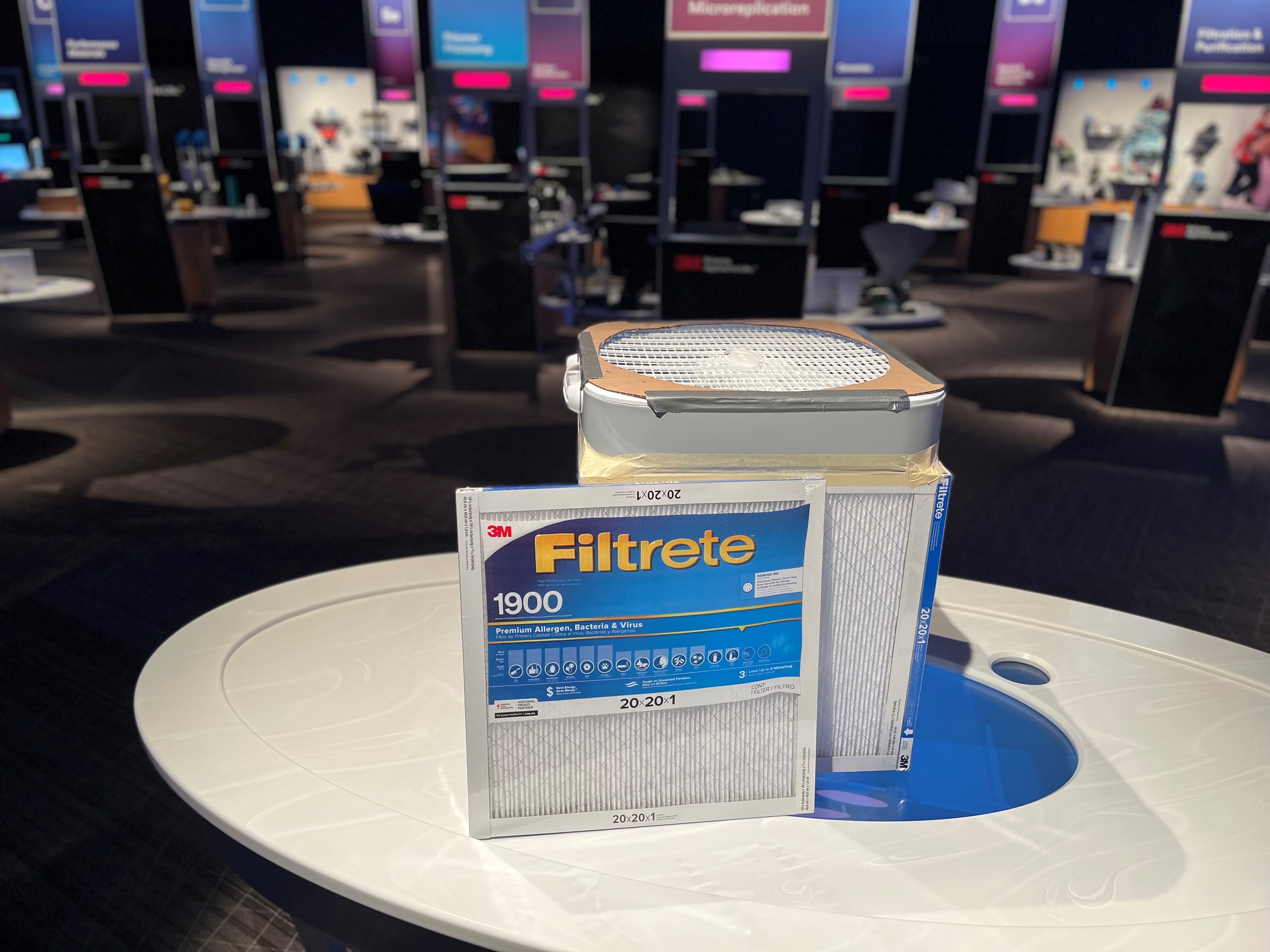
3M scientists: This Corsi-Rosenthal box movement is legit

 What can you build with duct tape, air filters, and a box fan?

This might sound like the set up for a dad joke, but according to new insights from 3M, the answer is less of a punchline and more a breath of fresh air: Corsi-Rosenthal boxes.

What is a Corsi-Rosenthal box?

The box is a do-it-yourself air filtration device that is an alternative to traditional air purifiers on the market. It was popularized by an indoor air quality researcher and an air filtration expert in the summer of 2020 and designed to help reduce the number of virus-laden aerosol particles in indoor settings.

The design is straightforward. You need one box fan, four high-quality air filters, duct tape and some cut-out cardboard. Most boxes can be constructed in less than 45 minutes with materials costing about $80 to $100.

But does it work?

The short answer is yes.


https://news.3m.com/2022-02-24-3M-scientists-This-Corsi-Rosenthal-box-movement-is-legit