
Press Release - Thursday, March 16, 2023
Showing posts with label HEPA filters. Show all posts
Showing posts with label HEPA filters. Show all posts
Thursday, November 2, 2023
Friday, August 25, 2023
Wednesday, August 23, 2023
Why Haven’t We Made It Safer to Breathe in Classrooms?

In March 2021, Congress allocated $122 billion for schools to cope with the Covid pandemic and its aftermath — to hire tutors, retain teachers or improve their facilities. Public health and clean air advocates hoped that this would lead to widespread improvements in classroom ventilation and air quality to help ward off future pathogenic threats and reduce problems like dust, allergens and wildfire smoke.
But only about 34 percent of school districts said they used any of the money to upgrade their heating ventilation and air-conditioning systems, according to a recent survey from the Centers for Disease Control and Prevention. About 28 percent more installed in-room air cleaners, 8 percent said they installed ultraviolet lights — a more expensive and complicated method — and the rest reported no changes that would substantially improve air quality.
Moreover, once the federal spending was approved, aggressive salespeople descended on school officials who were struggling to open. School officials often were persuaded to spend more for products that many scientists believe aren’t substantially more effective than cheaper alternatives that have been thoroughly studied. Some of the products could even be dangerous...
Saturday, March 25, 2023
Illinois Department of Public Health Launches $30 Million Program to Distribute Air Purifiers in Illinois Schools - 60,000 HEPA (High Efficiency Particulate Air) purifiers to Illinois schools to help reduce the transmission of respiratory viruses, including COVID-19.
IDPH Launches $30 Million Program to Distribute Air Purifiers in Illinois Schools
CHICAGO - Governor JB Pritzker and the Illinois Department of Public Health (IDPH) announced today that the state is launching a $29.6 million program to distribute more than 60,000 HEPA (High Efficiency Particulate Air) purifiers to Illinois schools to help reduce the transmission of respiratory viruses, including COVID-19.
IDPH is coordinating the program with the Illinois State Board of Education (ISBE). The program is funded by the CDC through the American Rescue Plan Act of 2021 and is targeted for school districts that serve lower income communities and counties that have elevated air pollution counts. IDPH estimates almost 3,000 schools will be eligible for the program, covering 68 percent of school districts in the state. It will cover schools throughout the state, including Cook County, with the exception of Chicago, which has received a separate federal grant.
"There is nothing more important to me than keeping Illinoisans safe and healthy—especially when it comes to our youth," said Governor JB Pritzker. "We know that our children need to stay healthy and study in classrooms that are well-ventilated in order to thrive and succeed. Thanks to this $30 million investment, schoolchildren will experience cleaner air—preventing illness and absenteeism, while improving our children's ability to think and learn."
"I have devoted much of my career to protecting and promoting the health of children," said IDPH Director Dr. Sameer Vohra, who is a pediatrician. "Data over these last three years have shown us the critical importance of good ventilation to keep children and adults safe from respiratory illnesses. These HEPA air purifiers are a significant investment in our children, and I am very excited that the State of Illinois can make this impact. They will keep kids healthy and in school, ensuring more opportunities for learning and success for years to come."
"Every Illinois student deserves a safe, healthy learning environment regardless of zip code or income level," said State Superintendent of Education Dr. Tony Sanders. "Improving classroom ventilation with air purifiers is a proven method we can use to reduce the transmission of respiratory viruses, including COVID-19, the flu, and RSV, and, at the same time, reduce absences related to illness. A child's health and attendance is inextricably tied to their ability to learn, and I'm pleased the State is making this vital investment."
IDPH is launching an enrollment process in coordination with ISBE through which schools can submit orders for portable HEPA air purifiers. The administrators of eligible school districts will be contacted directly with information about how many purifiers that their districts are eligible to receive. The portable air purifiers will be delivered to school districts in the coming months. Schools will generally be eligible for one small air filter unit for each 20 students in a school, with a limited number of larger units for districts with more than 1,000 students.
Questions from school administrators should be directed to the IDPH Air Purifier Project Inbox at DPH.AirPurify@illinois.gov.
Studies show that cleaner air can reduce absentee rates, and improve students' abilities to think, learn, read and solve math problems.
Last year IDPH issued ventilation guidance to educate the community on the impact of ventilation systems and to provide information about low cost and DIY interventions for ventilation upgrades.
Tuesday, October 18, 2022
Ventilation and filtration reduce exposure.
Ventilation and filtration reduce exposure.
— Jon Levy (@jonlevyBU) October 15, 2022
Masks reduce exposure.
COVID infection risk is a probabilistic function of exposure.
So lower exposure = less infection.
These are facts.
We can debate policies, tradeoffs, significance of infection, etc. But facts are facts.
Wednesday, September 28, 2022
Are you looking for a quick and easy was to explain the steps necessary for safer indoor environments? Here it is.
Are you looking for a quick and easy was to explain the steps necessary for safer indoor environments? Here it is. A collaboration between the engineer @joeyfox85 and the artist @calgaryhester. Thanks https://t.co/nUZoCombuY
— Jim Rosenthal (@JimRosenthal4) September 20, 2022
Monday, September 26, 2022
Excellent chart giving pros and cons of different air cleaning techniques. This should be distributed to every school administration so that they can adequately assess what they are purchasing.
Excellent chart giving pros and cons of different air cleaning techniques. This should be distributed to every school administration so that they can adequately assess what they are purchasing. It is pretty hard to go wrong with fans and filters. https://t.co/8elGBBCgTi
— Jim Rosenthal (@JimRosenthal4) September 20, 2022
Friday, September 16, 2022
A DIY air purifier that costs under $100 to make is taking America’s classrooms by storm [But not @mcps @mocoboe !!!]

Taneja found a potential answer in the same place many of us look: online. Reading about a do-it-yourself air filtration system designed to reduce aerosol particulates, he realized he could construct such a model for his own home at a fraction of the cost of a commercial HEPA purifier. Taneja quickly offered to build similar systems for others in his community at cost–and the requests came pouring in. A DIY solution to filtering the air had suddenly grown legs.
“My family’s living room became a warehouse for storing filters and fans,” Taneja told me. Since December, he says, he has delivered scores of home-built filtration systems, primarily to seniors and the immunocompromised who might not be able to do so for themselves.
All this would be impressive under any circumstance. It’s slightly more so when you consider that Taneja is 15 years old. And as we move into what may well be the endemic phase of Covid, his solution is one that many others around the world are also finding...
A DIY air purifier that costs under $100 to make is taking America’s classrooms by storm | Fortune
Thursday, September 8, 2022
Sure @MCPS this is all fine and dandy hand waving but where is the real commitment to air quality and monitoring, ventilation, and filtration?
Sure @MCPS this is all fine and dandy hand waving but where is the real commitment to air quality and monitoring, ventilation, and filtration? Not even a mention of these easy and effective interventions. https://t.co/vz0WSk1gzc
— Danielle R Snowflack, Ph.D. (@drsnowflack) August 25, 2022
~~~~~~~~~~~~~~~~~~~~~~~~~~~~
IMPORTANT MESSAGE FROM THE MCPS SCHOOL SYSTEM MEDICAL OFFICER
Dear MCPS Community,
We are so excited to be back together next week for the new school year! As we return to shared spaces, the health and wellness of our students and staff remains a top priority. We have more tools, experience and knowledge than ever to help reduce the impact of COVID-19 in our school community. Here are some important things to know about vaccination, testing and masking as staff and students return to school:
COVID-19 Vaccination Helps Our School Community
Vaccines are an important way to lower individual risk of severe complications from COVID-19 infection. A high vaccine coverage rate helps reduce the overall burden of COVID-19 on the school community and helps keep learning going, as individuals with milder symptoms will miss fewer school or work days. We continue to strongly recommend students receive all recommended COVID-19 vaccines and boosters for which they are eligible. At this time, COVID-19 vaccination is required for staff unless approved for a medical exemption. We will continue to provide opportunities for students, staff and family members to receive COVID-19 vaccines at after-school and weekend events.
Rapid Testing for COVID-19 for a Strong School Year Start
Montgomery County Public Schools (MCPS) is encouraging at-home rapid testing for COVID-19 as staff and students return to school. Testing is an important way to identify individuals actively positive for COVID-19 who should temporarily isolate in order to prevent further transmission and keep our school community as healthy as possible.
End-of-summer activities, such as returning from travel or getting together with larger groups, can increase the risk of exposure to COVID-19. Staff and students may consider testing even after school begins, following Labor Day holiday travel or after higher-risk social events that may coincide with the start of the school year. Testing is not mandatory. We are depending on our staff and families to consider their exposure risk, and test and report positive results accordingly.
Test kits will be available at schools, at the MCPS Annual Back-to-School Fair on Aug. 27, and upcoming school-based weekend vaccination clinics on Aug. 27 and Aug. 28. Free rapid test kits are also available to Montgomery County residents at most public library locations, or by mail for home delivery from the U.S. government. Only positive test results need to be reported using the MCPS COVID-19 Reporting Form. Individuals who have a positive COVID-19 test should report their positive result and follow CDC guidelines for isolation.
Masking
As of today, the CDC COVID-19 Community Risk Level for Montgomery County is “low.” At this time, masking is not mandatory in MCPS buildings or buses in most situations. Health room staff actively engaged in patient care or anyone assisting with medical procedures must follow infection control guidelines from the DHHS and the CDC, including wearing a mask when required.
In addition, masking may be temporarily required for individuals or groups, in certain circumstances:
- A student develops symptoms of COVID-19 during the school day and presents to the health room for evaluation
- A student has tested positive at school for COVID-19 and is awaiting pick-up
- In outbreak situations, as an alternative to quarantine for exposed individuals who do not have symptoms of COVID-19
- For students or staff recovering from COVID-19 who have completed at least five full days of isolation, and feel well enough to return to school or work.
Recommendations and requirements for masking can be expected to change during the school year, as COVID-19 data trends and science change. For individuals who cannot safely mask, other prevention measures will be used.
Please remember that all staff and students are supported in their decision to wear a mask for individual protection, at any risk level. MCPS will continue to provide masks for staff and students for use during the school day.
The new school year is just around the corner! Let’s work together to keep our school community well, as we return with excitement, renewed purpose and joy.
Sincerely,
Patricia Kapunan, M.D.
MCPS Medical Officer
Wednesday, September 7, 2022
How's the air quality in Quebec schools? Here's what we found

As fall approaches, the Montreal Gazette visited several everyday places to see how CO2 levels compare to those measured in classrooms.
...Teachers submitted readings higher than 4,000 ppm on six occasions, all from different schools. The highest reading, 4,941 ppm, was recorded in a private high school classroom in the Laurentians. The lowest, 406 ppm, was taken in a high school on the South Shore.
Drouin has urged the government to release the raw data behind the C02 measures it tracks, arguing that basing decisions on averages doesn’t make sense.
“If one afternoon, a classroom is at 4,000 ppm, it’s in that moment that you could be at risk of catching COVID,” Drouin said. “Of course, there will be peaks and valleys, but it’s the peaks that are most important. Because that’s when you’re breathing other people’s air.”..
How's the air quality in Quebec schools? Here's what we found | Montreal Gazette
Monday, September 5, 2022
How to build Corsi-Rosenthal Box to protect against COVID for under $100 #COVIDisAirborne
Life in many places has largely returned to a pre-pandemic normal. People are tired of masking and remaining socially distant, even though contagious COVID-19 variants show no signs of going away anytime soon.
With attitudes toward COVID-19 becoming increasingly lackadaisical, public health experts are touting ventilation as a less-intrusive way to stop tiny particles carrying the virus from traveling through the air. But uptake of better ventilation practices — which can range from expensive to unrealistic — has been slow.
Enter the Corsi-Rosenthal Box, a do-it-yourself air filtration system that has taken the internet by storm. Each box typically costs under $100 to make and is more effective than other, pricier options like High Efficiency Particulate Air filters.
The simple contraption consists of a box fan, four MERV13 furnace filters that can be purchased online or in store, some cardboard and strips of tape. It’s the brainchild of air quality researcher Richard Corsi, dean of engineering at the University of California, Davis, and Jim Rosenthal, CEO of Texas-based company Tex-Air Filters...
How to build Corsi-Rosenthal Box to protect against COVID for under $100 | The Seattle Times
Friday, September 2, 2022
Benefits of clean indoor air in school classrooms...
Benefits of clean indoor air in school classrooms...
— Kimberly Prather, Ph.D. (@kprather88) August 27, 2022
1. Better cognitive function
2. Lower risk of inhaling SARS2
3. Lower risk of flu and other respiratory diseases
4. Less inhalation of wildfire smoke and air pollution
5. Less absences
6. Less allergies
7. Please add to list
Thursday, September 1, 2022
Installing air filters in classrooms has surprisingly large educational benefits

An emergency situation that turned out to be mostly a false alarm led a lot of schools in Los Angeles to install air filters, and something strange happened: Test scores went up. By a lot. And the gains were sustained in the subsequent year rather than fading away.
That’s what NYU’s Michael Gilraine finds in a new working paper titled “Air Filters, Pollution, and Student Achievement” that looks at the surprising consequences of the Aliso Canyon gas leak in 2015.
The impact of the air filters is strikingly large given what a simple change we’re talking about. The school district didn’t reengineer the school buildings or make dramatic education reforms; they just installed $700 commercially available filters that you could plug into any room in the country. But it’s consistent with a growing literature on the cognitive impact of air pollution, which finds that everyone from chess players to baseball umpires to workers in a pear-packing factory suffer deteriorations in performance when the air is more polluted.
If Gilraine’s result holds up to further scrutiny, he will have identified what’s probably the single most cost-effective education policy intervention — one that should have particularly large benefits for low-income children...
https://www.vox.com/2020/1/8/21051869/indoor-air-pollution-student-achievement
Wednesday, August 31, 2022
Kids need fresh air to learn. This is known. Fresh air improves cognitive function. This is known. Your kid’s classroom probably does not have fresh air, and easily could.
Kids need fresh air to learn. This is known. Fresh air improves cognitive function. This is known. Your kid’s classroom probably does not have fresh air, and easily could. pic.twitter.com/2UTSVX9Vnn
— Joe Oliver (@joeolivermd) August 27, 2022
Tuesday, August 30, 2022
Equivalent CO2 - A New Invention I've been working with @KashPrime on the Raven Clean Air Map. https://ravenapp.org/cleanair We want to use CO2 to assess our risk of airborne transmission, but monitoring CO2 has a bunch of limitations. Is there any way we can address them?
Equivalent CO2 - A New Invention
— Joey Fox, P. Eng, M.A.Sc (@joeyfox85) August 23, 2022
I've been working with @KashPrime on the Raven Clean Air Map. https://t.co/RulXcH0D4T
We want to use CO2 to assess our risk of airborne transmission, but monitoring CO2 has a bunch of limitations. Is there any way we can address them?
1/11 pic.twitter.com/GluJFfq9SN
Friday, August 26, 2022
Biden Brings His Own Ventilation to @mcps High School #COVIDisAirborne #CO2
On Thursday, August 26, 2022, President Joe Biden held a rally in the gym of Richard Montgomery High School in Rockville. Montgomery County is currently in a period of HIGH COVID-19 Transmission with a Positivity Rate of 11.65%. What's a President to do with a potential super spreader event? Why, bring his own ventilation, of course!
"respiratory etiquette"**
Take a look at the air handling units that were added to the outside of the Richard Montgomery High School gym for President Biden's rally.
How do MCPS students that use this gym year round get the same type of ventilation upgrade for their use of this space?
**So in 2022,
@mcps
takes a hard pass on ventilation/air purification upgrades but leans in on Here’s the other side of the wall. Look what they have to do to cool that Rocket air! 🚀 👊 pic.twitter.com/TIlaLxZeOt
— Jeremy Koenig 📚 (@KoenigRMHS) August 25, 2022
Meanwhile, MCPS parents continue to advocate for the Board of Education to acknowledge that #COVIDisAirborne. The President of the United States gets it, why doesn't the Board of Education get it?
So in 2022, @mcps takes a hard pass on ventilation/air purification upgrades but leans in on <checks notes> "respiratory etiquette" pic.twitter.com/9s7l2auyEa
— Lloyd Matthews (@Mlloyd_2010) August 25, 2022
Every time someone says we are in a “different place” in the pandemic and “have the tools” to operate schools safely and without disruption… ask them how many local schools have classrooms with 6+ air exchanges per hour; had their HVAC systems upgraded?
Every time someone says we are in a “different place” in the pandemic and “have the tools” to operate schools safely and without disruption… ask them how many local schools have classrooms with 6+ air exchanges per hour; had their HVAC systems upgraded?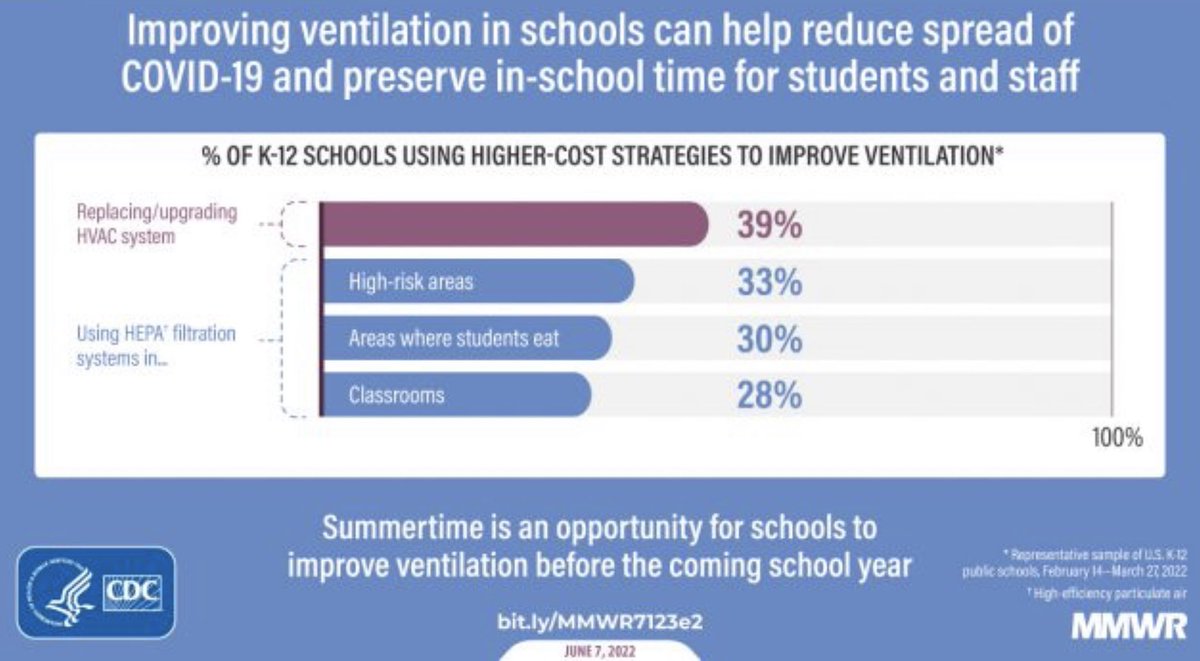
This report highlights the time that has been squandered by far too many regions despite funding available. Through a widespread failing, these disparities hit poor and predominantly minority schools hardest.
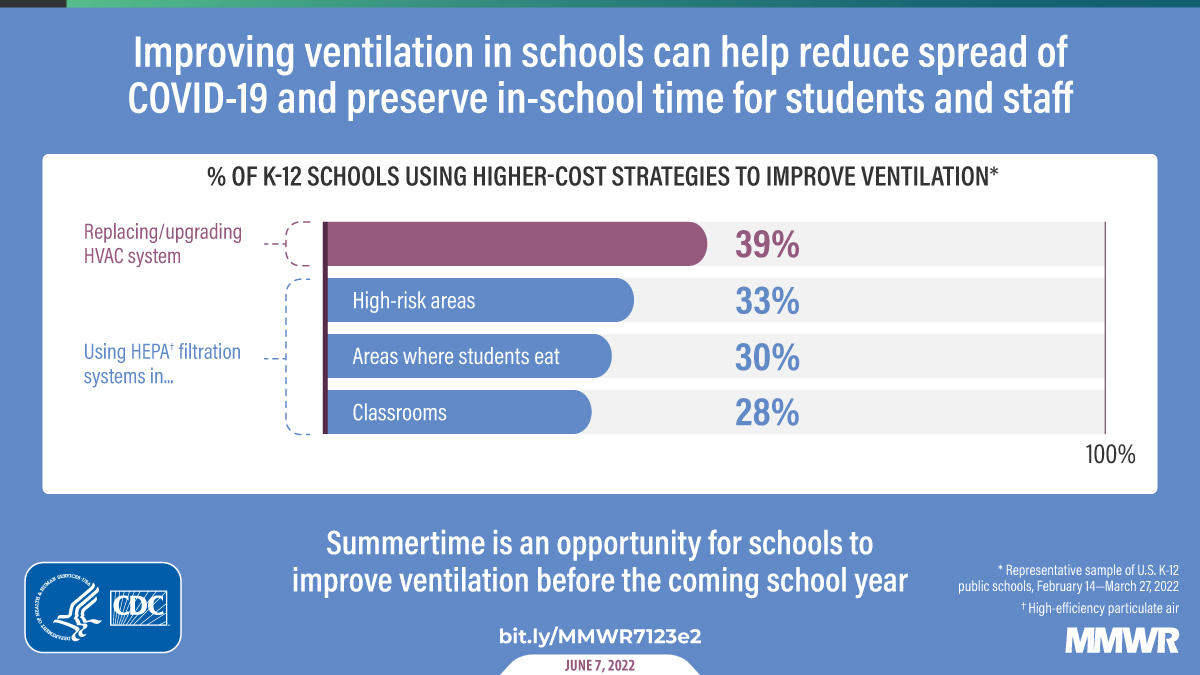
These improvements truly could make schools a safer and healthier environment for the long term, yet the confluence of minimizing the impact of COVID on kids, habitual lack of support of 💰, & the demonization of teachers who called for safer working conditions has led us here.
CDC’s new guidance on the acquiescence to a new “normal” calls for the use of prevention methods that we know are not being used sufficiently in most places, and resists those that could help stem the tide in their stead.
This is isn’t public health.
This is isn’t public health.
H/T to @betsyladyzhets for her piece in Time highlighting this issue.
Please also look to experts such as @jonlevyBU who approach this issue mindful of the inequity that exists in environmental health for schools.
• • •
Thread by @pwhickey on Thread Reader App – Thread Reader App
Toronto: Website logs carbon dioxide levels to help assess COVID-19 risk

By Dilshad Burman
Posted Aug 23, 2022, 6:11PM EDT.
Last Updated Aug 23, 2022, 6:37PM EDT.
A new web app aims to help people assess their risk of contracting COVID-19 in a particular space by logging carbon dioxide (CO2) levels at different locations across the city.
The app was developed by a three-person team including Toronto emergency room physician Dr. Kashif Pirzada.
“Lets say you’re in a room full of people — everyone breathes out carbon dioxide. If there’s a lot of carbon dioxide in that space, that means the ventilation system is not moving it out. That means all the viruses in the air from those people is still in the air too … and the more likely you are to get COVID,” he explains.
Anyone can log CO2 levels on the Raven Clean Air app wherever they are with the help of a portable monitor and the numbers are reflected on a map. Pirzada says in broad terms, outside air has a baseline CO2 level of about 420 parts per million (ppm). For indoor air, 800 to 1,000 ppm is acceptable. Above 1,000 ppm indicates poor ventilation.
“There’s about 500 users around the world in about 10 countries now. And we have about a thousand data points around the world,” says Pirzada. “Overall we have 150 cities — In Canada, where the majority of them are, maybe 70 or 80 cities.”
Currently, information is being logged both by the general public and local volunteers like pre-med students.
“I just go on to the app and then I log in where I was, the CO2 levels and the time and the weather and [approximately] how many people are in the space, what time it is and all those different details and I just log it in and that’s it,” explains volunteer Bahja Farah.
“It’s extremely useful, especially for people with underlying conditions or someone that’s vulnerable – it really helps to know whether you should be in these areas or whether you should protect yourself in these areas,” says Sidone Grange, another volunteer.
They add that it also has many practical applications in their daily lives, like deciding which restaurant to go to or whether they feel it necessary to wear a mask in an indoor space.
In addition, Pirzada says as back-to-school season approaches, monitoring CO2 levels in school will be very useful.
“CO2 is a way to tell if your school’s ventilation for your child is good. So you can share that data with other parents and you can prevent your child from getting COVID potentially,” he says. “That’s a big win because in hospitals where I work, the last wave was driven by kids getting sick, getting their parents sick, getting their grandparents sick. These people fill the hospitals and collapse the healthcare system. So getting this information out there is extremely important right now.”..
https://toronto.citynews.ca/2022/08/23/carbon-dioxide-monitoring-app-covid-19-prevention/
Monday, August 22, 2022
Your Kid's School Needs Better Ventilation to Help Keep COVID-19 in Check

In response, some parents and experts are trying to improve ventilation in schools, since better air quality in buildings can reduce COVID-19’s spread and even improve other health outcomes. But, despite readily available resources—including millions of dollars in funding from the federal government—many schools have not invested in upgrading their air quality...
Wednesday, August 10, 2022
Look what some awesome #Arlington Girl Scouts built 💪 for kids in schools in @APSVirginia , @fcpsnews , and @FCCPS . DIY air filter boxes to clean the air
Look what some awesome #Arlington Girl Scouts built 💪 for kids in schools in @APSVirginia, @fcpsnews, and @FCCPS.
— @SmartRestartAPS (@smartrestartaps) August 9, 2022
DIY air filter boxes to clean the air
FYI: @CorsIAQ, @JimRosenthal4, and @DavidElfstrom, and @CleanAirCrewOrghttps://t.co/5MtrrFFGl0
Subscribe to:
Posts (Atom)