Good evening, superintendent Taylor and members of the Board. We are members of the MCPS
Student Climate Action Council or SCAC, a student-composed, Board-sanctioned group seeking to create a
green school system.
As you all know, the SCAC combines a multitude of perspectives from different schools throughout the
county, and we work to reduce MCPS’s environmental impact while providing support for student sustainability
projects.
The SCAC is currently working to formulate a Climate Action Plan to support the school system in
reaching its emissions and sustainability goals of an 80% reduction in carbon emissions by 2027 and 100% by
2035. One of the main pillars of the plan is clean energy, which is crucial to reducing Montgomery County’s
carbon footprint. The two components of this pillar that we want to focus on tonight are energy conservation
and efficient HVAC systems.
MCPS should be conscious about their energy usage when updating current facilities or building new ones,
particularly by harnessing more solar power. Currently, MCPS has 17 solar sites at their schools. However,
MCPS has over 200 schools, meaning these solar sites make up less than 10% of the total. MCPS should
increase the amount of schools that utilize solar power, given the multitude of benefits it offers. These benefits
include reduced electricity costs, zero carbon emissions, lower maintenance needs, and educational
opportunities for students to learn about renewable energy first-hand. In fact, MCPS has saved over 300,000
dollars because of solar power.
Ensuring that current buildings are renovated to be all-electric is another priority. Converting to electric heating
systems and appliances will create healthier learning environments for our students by improving indoor air
quality, while significantly reducing our schools' carbon footprint. This would decrease our reliance on
unsustainable energy practices and would also benefit our school system in the long term.
MCPS should also explore alternatives to reduce energy use, such as implementing cool roofs, which are
simply roofs painted white. They’re designed to reflect sunlight and thus reduce the internal temperature of the
building. In addition to being environmentally conservative, this design would also reduce air conditioning
costs.
Additionally, MCPS should prioritize keeping our HVAC systems up-to-date – Not only for the environment, but
also for our students. An issue that has been brought up time and time again amongst our students is MCPS’s
old, unreliable, breaking HVAC systems. These outdated systems create highly uncomfortable learning
conditions, and we must prioritize the success of our students by keeping these systems updated. Upgrading
these systems isn’t just about comfort—it's an investment in healthier, more productive learning spaces that
support both our students' well-being and our district’s environmental goals.
The environmental issues stemming from MCPS’ current HVAC systems are a result of their reliance on
outdated, inefficient technologies. These technologies consume excessive energy and use refrigerants with
high global warming potential, both of which are contributing to environmental harm. By expanding programs
such as MCPS’s already existing geothermal heating systems, MCPS can fortify its position as a climate
leader, enhancing energy efficiency, reducing emissions, and creating a better learning environment.
Advances in our county’s energy and HVAC systems will undoubtedly lower our County’s impact on the
climate, and will help create a green school system for future MCPS students. As the climate crisis worsens, it
is imperative that MCPS seeks to take immediate action on present environmental issues and unify their
response under an overarching Climate Action Plan. The integration of clean energy and
climate-consciousness into all parts of the school system will allow MCPS to reach its zero emissions goal by
2035. MCPS does not only have the ability to take these actions, it has a responsibility to do so; a
responsibility to the students, staff, and community whose futures will be affected by climate change. Thank
you
Classes are back in session at Thomas S. Wootton High School in Rockville, Maryland, after students were evacuated moments after the first bell rang Monday morning.
The school building was evacuated at about 7:20 a.m. due to a gas odor...
...Greencastle Elementary School, located at 13611 Robby Road, had an AC unit that caught on fire, according to Montgomery County Fire & Rescue Service (MCFRS) spokesperson Pete Piringer.
No students were at the school at the time of the fire. The fire was put out by school staffers, said Piringer...
MONTGOMERY COUNTY, Md. — Some Montgomery County public schools have grown mold over the summer due to high humidity and suboptimal HVAC systems, MCPS Superintendent Thomas Taylor said at a board meeting Wednesday.
The district is remediating schools across the county and in a handful of spots, Taylor said. Goshen Elementary School, New Hampshire Estates Elementary School and Loiederman Middle School are three schools that were mentioned by name...
...“During state testing this week, we were evacuated two times” in Tuesday’s heavy downpour, said 7th grade English teacher Kelly Rankin.
“We assumed there was something, like an actual fire,” she said. Later, the staff was told the alarm sounded due to the overheating of the system...
...Nolan, the SIEU union representative at Loiderman, said she recently was absent three days because of all the mold.
“Our kids can’t learn in these conditions,” declared Joshua Rubin, a world studies teacher, as staff, parents and students cheered and chanted, “Do Your Job” to school administrators.
“We have been through a number of smells. We have been through a number of odors,” said 7th grade English teacher Camilla Barillas, adding, “Frankly we deserve better.”
Sometimes it is 40 degrees in the classroom. Other times, it’s 90 degrees, said Rankin, who has had four different sinus infections. “We can’t wait any longer.”..
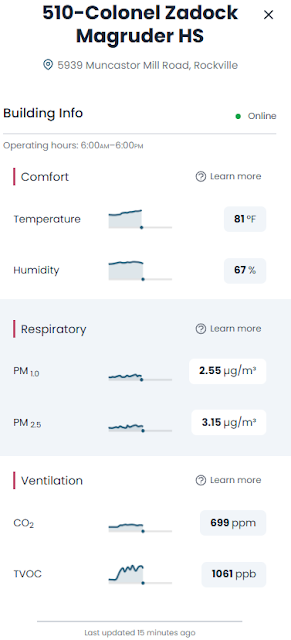
Magruder High School will be dismissing today, May 16, 2025, at 12:45 pm due to excessive heat in the building. Families, please see the community message that I sent to you for more details.
When Magruder High School was closed on May 16th, the AVERAGE interior temperature was 81 degrees and the AVERAGE humidity for the building was 67% at 12:30 PM.
Superintendent Thomas W. Taylor and the Board of Education pay millions of dollars for the temperature and humidity for every single room in every single school building in Montgomery County Public Schools, but they hide those details from parents and staff. All that is known is that these were the AVERAGES at the time the school was closed.
How hot were the hottest rooms and what was the highest humidity?
Clean indoor air protects against diseases such as COVID and flu, but we’re not doing enough to ensure it
Across the U.S., kids are headed back to their classrooms—just as COVID nears a fresh, late-summer peak. Somehow, four years into a viral pandemic that everyone now knows spreads through the air, most schools have done little to nothing to make sure their students will breathe safely.
We—and especially our children—should be able to walk into a store or a gym or a school and assume the air is clean to breathe. Like water from the faucet, regulations should ensure our air is safe.
“Air is tricky. You can choose to not partake of the water or the snacks on the table, but you can’t just abstain from breathing,” notes Gigi Gronvall, senior scholar at the Johns Hopkins Center for Health Security and an author of a 2021 report on the benefits of improving ventilation in schools.
The COVID-causing virus SARS-CoV-2 is far from the only airborne risk in schools. There are also other respiratory viruses, smoke from wildfires, mold spores, off-gassing from plastics and other compounds, air pollution from traffic and industry, and allergens that worsen asthma and add to sick days. Yet federal air standards are stuck in the 1970s, when they were mostly aimed at protecting people from secondhand tobacco smoke, says Joseph Allen, director of the Healthy Buildings Program at the Harvard T. H. Chan School of Public Health. Fully updated standards for buildings are years or even decades away.
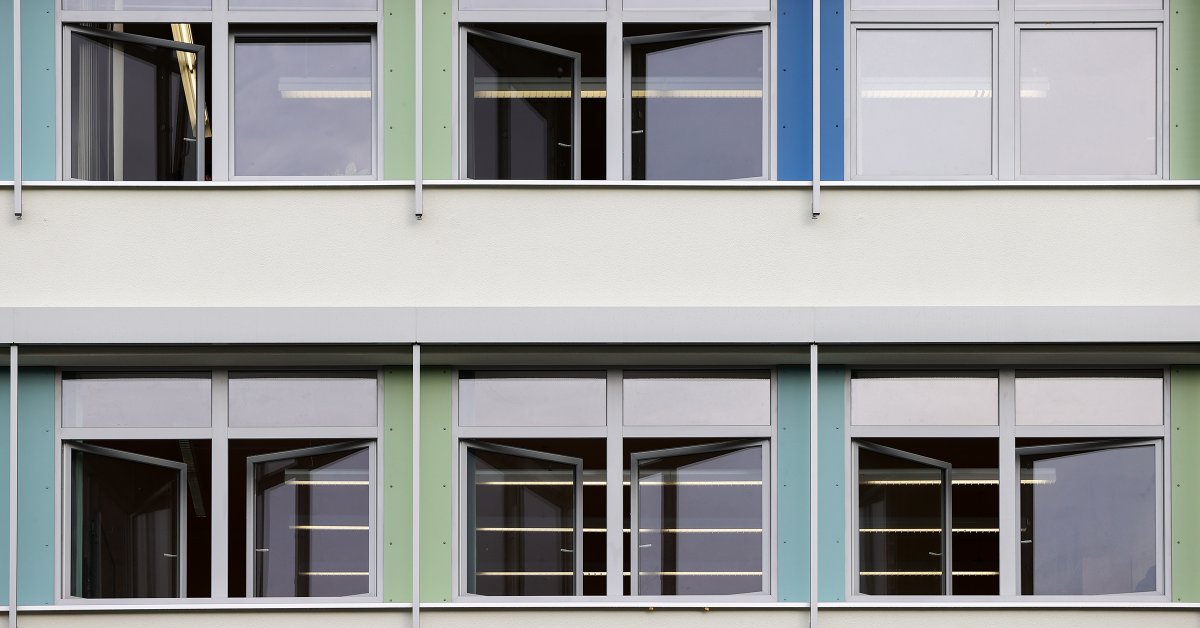
It’s hard to assess just what schools have or haven’t done to improve indoor air quality. No one—not one federal agency—collects nationwide air quality data on individual schools. Schools could use federal money to update air filtration and ventilation during the height of the pandemic. But a 2022 Centers for Disease Control and Prevention survey of school districts found that only half had taken simple steps such as opening windows or doors or using fans, and even fewer had upgraded ventilation systems...
Five Wootton High School students spoke Thursday at the Montgomery County Board of Education concerning the “unhygienic environment” and “crumbling infrastructure” at their school in Rockville.
Ashi Stanislaus, secretary of the student government association, told board members, “students face problems with the bathrooms every single day. There are many issues including mold, broken toilets, broken faucets, and bathrooms without mirrors.”
Many of those issues were pointed out to school officials last school year, she said...
During the weeks that Poolesville High School has been under construction, several students have reported nausea, headaches and difficulty concentrating.
The students and their parents say the symptoms started in February and are a reaction to fumes being emitted from tar used in renovations. They have asked Montgomery County school officials topause the work until students’ health concernsare addressed.
Krisna Becker, a parent of two at the school, said one of her daughters texted her on Feb. 14 asking to be picked up early because of how strong the fumes were from the construction work. Other students and teachers had also been complaining that morning. The school ended up releasing early that day because of an odor that came from “work done outside of school hours and windy conditions,” Montgomery County Public Schools spokeswoman Jessica Baxter said....
As fall temperatures cool across the U.S., many schools will struggle to ventilate classrooms while also keeping students and teachers comfortable and healthy. Children and teachers spendover six hours a dayin classrooms during the school year, often in buildings that aredecades oldand haveinadequate heating, ventilation and air conditioning, or HVAC, systems.
Fall 2022 marks the start of the fourth school year affected by the COVID-19 pandemic, which has spotlighted the importance of indoor air quality in schools. Ideally, all school buildings would have adequate ventilation, filtered air in each classroom and windows that open. Sadly, this is not the case – and indoor air quality in many schools is poor as a result. This is especially problematic in the wake of the U.S. Centers for Disease Control and Prevention’s August 2022 COVID-19 guidance for schools, which scales back other measures for limiting transmission, such as masking, testing and quarantining.
Beyond minimizing COVID-19 transmission, indoor air quality also matters for student academic performance. This is especially important given the learning losses that many children experienced in the first two years of the pandemic. Hot, stuffy classrooms make it harder for students to learn. So do cold classrooms.
Our research focuses on indoor environmentsand health – an area that has received increased attention during the pandemic, since most COVID-19 transmission occurs through shared air indoors. There is ample evidence that smart investments in school buildings can reduce transmission of infectious disease, while also improving learning and increasing well-being for students, teachers and administrators...
The school setting is an important site of SARS-CoV-2 transmission, new data suggest.
An analysis of surveillance data for almost 1000 exposures to SARS-CoV-2 found that students accounted for a higher proportion of infected individuals who caused onward transmission than did the public overall (46.2% vs 25%).
“Our analysis suggests that younger age groups were deeply involved in the spread of the infection,” wrote study author Stefano Merler, MSc, a fellow at the Bruno Kessler Foundation in Trento, Italy, and his coauthors. They added that “control programs targeting contexts responsible for most of the transmission could be effective in limiting the spread of the infection, including in educational settings.”
Excellent chart giving pros and cons of different air cleaning techniques. This should be distributed to every school administration so that they can adequately assess what they are purchasing. It is pretty hard to go wrong with fans and filters. https://t.co/8elGBBCgTi
Every time someone says we are in a “different place” in the pandemic and “have the tools” to operate schools safely and without disruption… ask them how many local schools have classrooms with 6+ air exchanges per hour; had their HVAC systems upgraded?
This report highlights the time that has been squandered by far too many regions despite funding available. Through a widespread failing, these disparities hit poor and predominantly minority schools hardest.
These improvements truly could make schools a safer and healthier environment for the long term, yet the confluence of minimizing the impact of COVID on kids, habitual lack of support of 💰, & the demonization of teachers who called for safer working conditions has led us here.
CDC’s new guidance on the acquiescence to a new “normal” calls for the use of prevention methods that we know are not being used sufficiently in most places, and resists those that could help stem the tide in their stead.
This is isn’t public health.
H/T to @betsyladyzhets for her piece in Time highlighting this issue.
Covid Funding Pries Open a Door to Improving Air Quality in Schools
Liz Szabo, Kaiser Health News
Many U.S. schools were in dire need of upgrades — burdened by leaking pipes, mold, and antiquated heating systems — long before the covid-19 pandemic drew attention to the importance of indoor ventilation in reducing the spread of infectious disease.
The average U.S. school building is 50 years old, and many schools date back more than a century.
So, one might assume school districts across the nation would welcome the opportunity created by billions of dollars in federal covid-relief money available to upgrade heating and air-conditioning systems and improve air quality and filtration in K-12 schools.
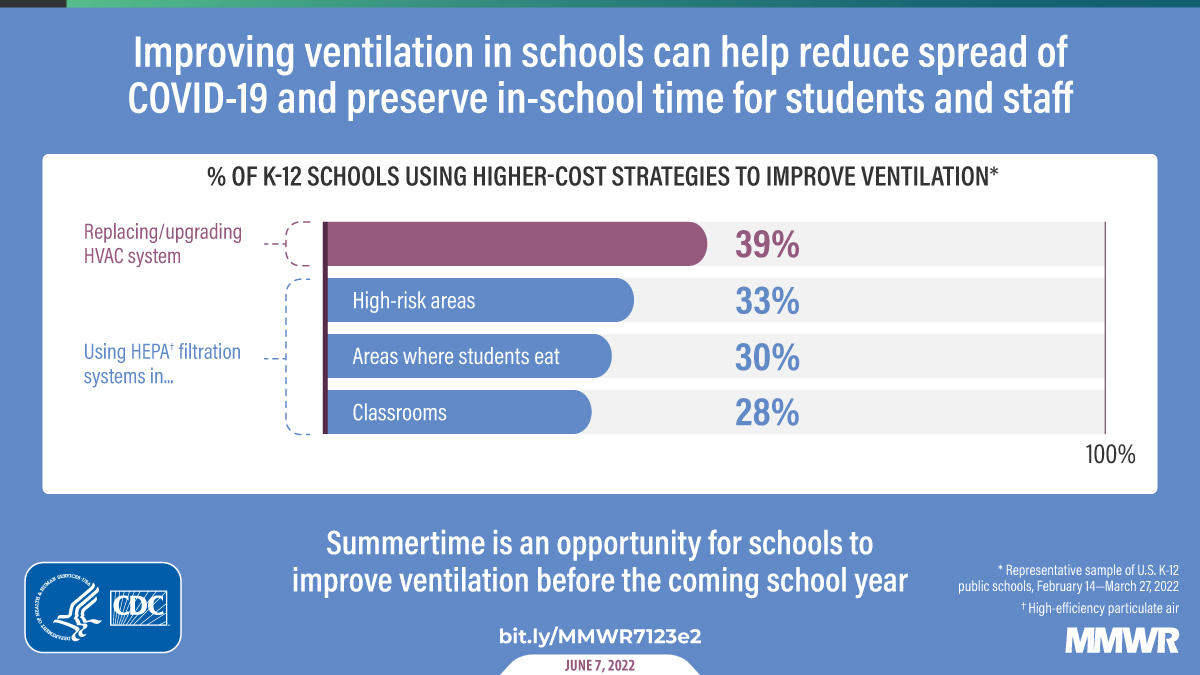
But a report released this month from the Centers for Disease Control and Prevention found most U.S. public schools have made no major investments in improving indoor ventilation and filtration since the start of the pandemic. Instead, the most frequently reported strategies to improve airflow and reduce covid risk were notably low-budget, such as relocating classroom activities outdoors and opening windows and doors, if considered safe.
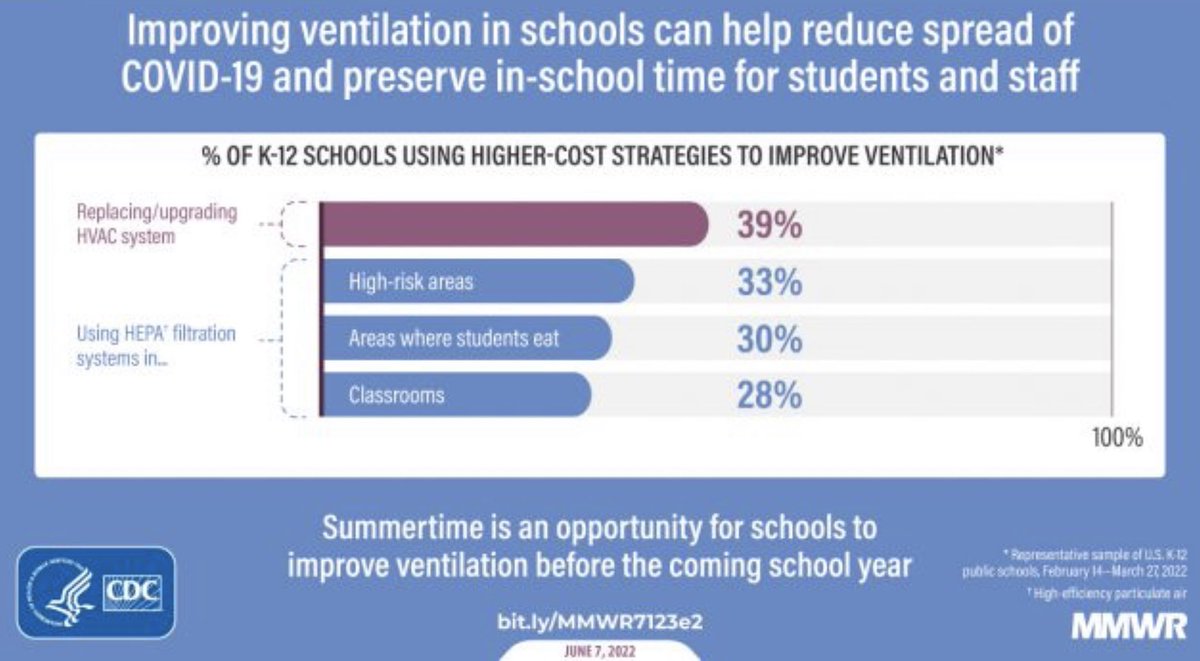
The CDC report, based on a representative sample of the nation’s public schools, found that fewer than 40% had replaced or upgraded their HVAC systems since the start of the pandemic. Even fewer were using high-efficiency particulate air, or HEPA, filters in classrooms (28%), or fans to increase the effectiveness of having windows open (37%).
Both the CDC and White House have stressed indoor ventilation as a potent weapon in the battle to contain covid. Congress has approved billions in funding for public and private schools that can be used for a broad range of covid-related responses —such as providing mental health services, face masks, air filters, new HVAC systems, or tutoring for kids who fell behind.
Among the sizable funding pots for upgrades: $13 billion for schools in the 2020 Coronavirus Aid, Relief, and Economic Security Act; an additional $54 billion approved in December 2020 for schools’ use; and $122 billion for schools from the 2021 American Rescue Plan.
“Improved ventilation helps reduce the spread of covid-19, as well as other infectious diseases such as influenza,” said Catherine Rasberry, branch chief of adolescent and school health at the CDC’s National Center for HIV, Viral Hepatitis, STD, and TB Prevention. “Investments made now can lead to lasting improvements in health.”
A wealth of data shows that improving ventilation in schools has benefits well beyond covid. Good indoor air quality is associated with improvements in math and reading; greater ability to focus; fewer symptoms of asthma and respiratory disease; and less absenteeism. Nearly 1 in 13 U.S. children have asthma, which leads to more missed school days than any other chronic illness.
“If you look at the research, it shows that a school’s literal climate — the heat, the mold, the humidity — directly affects learning,” said Phyllis Jordan, associate director of FutureEd, a think tank at Georgetown University’s McCourt School of Public Policy.
Clean-air advocates said the pandemic funding provides a once-in-a-generation opportunity to make the air more breathable for students and staff members with allergies and asthma, as well as helping schools in California and throughout the drought-stricken West weather the growing threat of smoke inhalation from wildfires.
“This is a huge deal for schools,” said Anisa Heming, director of the Center for Green Schools at the U.S. Green Building Council, a nonprofit that promotes ways to improve indoor air quality. “We haven’t had that amount of money coming from the federal government for school facilities for the last hundred years.”
Still, many school administrators aren’t aware that federal funding for ventilation improvements is available, according to a survey published in May by the Center for Green Schools. About a quarter of school officials said they did not have the resources to improve ventilation, while another quarter were “unsure” whether funding was available, according to the survey.
Even before covid spotlighted the issue of improving airflow, an estimated 36,000 schools needed to update or replace HVAC systems, according to a 2020 report from the Government Accountability Office.
Most schools don’t meet even minimum air quality standards, according to a 2021 report from the Lancet Covid-19 Commission. A pre-pandemic study of Texas schools found that nearly 90% had excessive levels of carbon dioxide, released when people exhale; high concentrations in the air can cause sleepiness, as well as impair concentration and memory.
Baltimore, Philadelphia, and Detroit — cities where many older buildings lack air conditioning — have all closed schools this spring due to excessive heat. And a year before the covid pandemic hit, schools in states including Alabama, Idaho, Michigan, Oklahoma, Tennessee, and Texas closed due to flu outbreaks.
Many schools have been slow to spend covid relief dollars because of the time-consuming process of hiring contractors and getting state or federal approval, said Jordan of FutureEd.
In the first year of the pandemic, many schools assigned custodial staff to wipe down surfaces frequently throughout the day. In Seattle, the district asked staffers to work overtime to help do that cleaning, said Ian Brown, a resource conservation specialist at Seattle Public Schools.
Some school officials say they feel pressured by parents to continue spending money on disposable wipes and surface cleaning, even though science has shown that the coronavirus spreads largely through the air, according to the Center for Green Schools’ report. Parents and teachers sometimes put more faith in conspicuous measures like these than in ventilation improvements that are harder to see.
And not all schools have spent federal funding wisely. A 2021 KHN investigation found that more than 2,000 schools across the country used pandemic relief funds to purchase air-purifying devices that use technology that’s been shown to be ineffective or a potential source of dangerous byproducts.
School districts are required to spend at least 20% of American Rescue Plan aid on academic recovery — such as summer school, instructional materials, and teacher salaries — leading some schools to prioritize those needs ahead of ventilation, Jordan said. But she noted that a FutureEd analysis of school district spending plans indicated districts intend to devote nearly $10 billion from the latest round of funding to ventilation and air filtration in coming years, budgeting about $400 a student.
Los Angeles schools, for example, have budgeted $50 million to provide 55,000 portable commercial-grade air cleaners for classroom use. Durham Public Schools in North Carolina is spending $26 million to update ventilation. Schools in St. Joseph, Missouri, plan to spend more than $20 million to replace aging HVAC systems.
In Boston, the school district has installed 4,000 air quality sensors in classrooms and offices that can be monitored remotely, allowing facilities managers to respond quickly when ventilation suffers.
Albemarle County Public Schools in Virginia, meanwhile, purchased “medical-grade” air purifiers for isolation rooms in school nurse offices, where children with covid symptoms wait for pickup. These units are equipped with HEPA filtration and interior ultraviolet light to kill germs, and are powerful enough to clean all the air in the isolation rooms every three minutes.
Seattle Public Schools used relatively inexpensive hand-held sensors to assess air quality in every classroom, Brown said. The district then purchased portable air cleaners for classrooms with inadequate ventilation rates.
While replacing a central air system is a major construction project that can easily top $1 million per school, quality HEPA purifiers — which have proven effective at removing the coronavirus from the air — run closer to $300 to $400.
About 70% of schools have at least inspected their heating and ventilation systems since the pandemic emerged, a key first step to making repairs, according to the CDC.
Engineers in Ann Arbor, Michigan, have inspected “every piece of mechanical ventilation in the school district, opening up every unit and inspecting the fans and pumps and dampers to make sure they’re operating properly,” said Emile Lauzzana, executive director of capital projects for Ann Arbor Public Schools.
“That’s just something that school districts don’t normally have the funds to do a deep dive on,” Lauzzana said. “It’s unfortunate that it took a pandemic to get us here, but we’re in a much better place with indoor air quality today.”
KHN (Kaiser Health News) is a national newsroom that produces in-depth journalism about health issues. Together with Policy Analysis and Polling, KHN is one of the three major operating programs at KFF (Kaiser Family Foundation). KFF is an endowed nonprofit organization providing information on health issues to the nation.
Sorry, this list is for Baltimore City Public Schools.
Montgomery County Public Schools doesn't believe in putting out this kind of basic information about their buildings.
The Parents' Coalition has received reports of MCPS school buildings without air conditioning today including McNair Elementary and Poolesville Elementary Schools. But that's only a partial list based on information we have received. The full list of schools with air conditioning issues is not available.
The schools listed below will close or have early dismissal on extremely hot days, or that feel warmer due to a combination of heat and humidity. Schools not listed below have air-conditioning (but may dismiss early, if their systems require repair that cannot be completed within one day).
Schools with air conditioning that is currently under repair and will close or have early dismissal on extremely hot days:
Academy for College and Career Exploration
Calvin M. Rodwell Elementary/Middle School
Dr. Bernard Harris, Sr., Elementary School
Garrett Heights Elementary/Middle School
George Washington Elementary School
George W.F. McMechen High School
Independence School Local I High School
North Bend Elementary/Middle School
Pimlico Elementary/Middle School
Sandtown-Winchester Achievement Academy
Tench Tilghman Elementary/Middle School
Westport Academy
Midtown Academy (building not owned by City Schools)
Youth Opportunity (building not owned by City Schools)
City Schools does not plan to install air-conditioning for these schools and alternative programs, because their buildings are not owned by the district:
Upgrading buildings’ ventilation, filtration and other factors would not only decrease COVID transmission but also improve health and cognitive performance in general
We spend 90 percent of our lives indoors, yet most of us seldom spare a thought for the quality of the air we breathe there.
More than a century ago, pioneering nurse and statistician Florence Nightingale proclaimed the importance of open air and bedroom ventilation for tuberculosis patients. Today in Nordic countries, it is common practice to let babies nap outside, sometimes in freezing temperatures. But even though humans have long attributed health benefits to fresh outdoor air, it is a lesson many of us seemed to have largely forgotten—until the COVID-19 pandemic forced us to relearn it.
It is now widely acknowledged that SARS-CoV-2, the virus that causes COVID, is frequently transmitted by airborne droplets called aerosols that hang in the air and can travel over short and long distances. “This is a virus that spreads through the air almost exclusively indoors. If we start there, then the building matters,” says Joseph Allen, an associate professor at the Harvard T. H. Chan School of Public Health and director of its Healthy Buildings program...
OVERVIEW Many countries have prioritized schools in their COVID-19 pandemic recovery plans, including providing funding to support costs associated with reopening safely. These resources represent a once-in-a-generation opportunity for health-based improvements to school buildings, such as improving indoor air quality (IAQ), which can reduce the risk of airborne infectious disease transmission as well as benefit health and academic performance. Unfortunately, there are reports of schools spending millions of dollars on unproven or largely ineffective air cleaning technologies like ionizers and other measures such as surface disinfection supplies.1-5
School infrastructure has been chronically underfunded, and schools may never see another influx of monies like this. Therefore, it is imperative that pandemic relief for schools be applied to enhancements that are evidence-based, provide longterm value, and do not create additional pollutants that may be harmful to the health of students, teachers, and staff. In this report, we provide a brief overview of the science on ventilation and air cleaning in schools, and then provide a guide on how to direct resources toward building-level public health interventions in school buildings that are best supported by scientific evidence to reduce the risk of COVID-19 transmission and promote long-term health and academic performance.