Thursday, May 27, 2021

Children Ages 2 and Up Who Aren’t Fully Vaccinated Should Continue to Wear Face Masks, the American Academy of Pediatrics Recommends


Itasca, Ill. -- In updated face mask guidance, the American Academy of Pediatrics (AAP) recommends the continued use of a well-fitting face mask for children and teens who are age 2 years and older and not yet fully vaccinated.

In addition to protecting the child, the use of face masks significantly reduces the spread of severe SARS-CoV-2 and other respiratory infections in schools and other community settings, the AAP notes. Use of face masks at home also may be vital in households that include medically fragile, immunocompromised or at-risk adults and children.

The use of face masks should continue until children or adolescents are fully vaccinated, which is two weeks after the final COVID-19 vaccine dose has been administered.

“The COVID-19 vaccines are remarkably effective, but we must stay vigilant,” said AAP President Lee Savio Beers, MD, FAAP. “Children under age 12 are not yet eligible for the vaccine, so it’s smart to be cautious and careful, especially when they are playing with friends, accompanying their parents to the grocery store, attending school or camp, and in any other situation in which they are around groups of people, some of whom may not be fully vaccinated.”

Other recommendations from the updated guidance:

  • Pediatricians are encouraged to discuss infection control practices with their patients and families.
  • Wearing a face mask protects others as well as the wearer, especially if they are not vaccinated and/or are around others who are not vaccinated. CDC guidance now states that face masks and physical distancing are no longer needed for persons who are fully vaccinated unless it is required by federal, state, local, tribal, or territorial laws, rules, and regulations, including local businesses and workplace guidance.
  • Schools, child care programs, and camps are encouraged to continue to support the use of face masks for children and staff until the vaccine is available for younger age groups and vaccinations within the pediatric population are high enough to prevent transmission of SARS-CoV-2.
  • Face mask use should be continued for those who are unvaccinated and playing indoor sports (except for sports in which the mask may become a hazard) and outdoors sports that have close contact (see AAP interim guidance on Return to Sports and Physical Activity).
  • Face masks should be worn any time people are traveling on a plane, bus, train, or other form of public transportation traveling into, within, or out of the United States and in airports, train stations and at bus stops.
  • A face mask is not a substitute for physical distancing. For those who are unvaccinated, face masks should still be worn in addition to physical distancing indoors around people who do not live in the household. Face masks should be used outdoors for those who are unvaccinated if in large group settings and/or when physical distancing recommendations cannot be maintained.

To request a copy of the guidance or an interview, please contact Lisa Black at lblack@aap.org or Emily Rosenbaum at erosenbaum@aap.org. 

The American Academy of Pediatrics is an organization of 67,000 primary care pediatricians, pediatric medical subspecialists and pediatric surgical specialists dedicated to the health, safety and well-being of infants, children, adolescents and young adults. For more information, visit www.aap.org. 


https://services.aap.org/en/news-room/news-releases/aap/2021/children-ages-2-and-up-who-arent-fully-vaccinated-should-continue-to-wear-face-masks/

2018 Article on Mohammed Choudhury (Next MD State Superintendent) Mohammed Choudhury: In America’s most economically divided city, a ‘diverse-by-design’ prophet is weeding out segregation, one equity audit at a time


By 
Beth Hawkins

September 25, 2018

San Antonio, Texas

Mohammed Choudhury grew up in Los Angeles, “a minority amongst minorities.” His parents emigrated from Bangladesh in the 1980s, a moment he sees in retrospect as an easier time for immigrants to establish themselves. His parents saved up, opened a restaurant in West Hollywood, and worked their way into the middle class.

They sent their kids to the neighborhood school, which had students from all over the world, something Choudhury loved. He knows now, as a rising star in education leadership, that it was academically lackluster. But from his parents’ perspective, the school was the gateway to the self-determination they came to the U.S. seeking...

...Fast-forward not so many years, and Choudhury, 34, is leading a closely watched effort by the San Antonio Independent School District to open dozens of innovative new, diverse-by-design schools. Because virtually all of the district’s 50,000 students are impoverished, to create that diversity he must both attract affluent families from outside the district and ensure that children from the most isolated, destitute families within it are represented in these exciting new schools...

...“One of the things that we told ourselves is we’re not going to do school choice … in a way that exacerbates segregation,” he says. “We’re not going to create a system [that has] our hands and fingerprints on it that allows a few winners and lots of losers.”..

...Three elements are indispensable in creating a system of schools that’s equitable and sustainable, in Choudhury’s view. The first is schools with attractive themes or instructional models, such as Montessori or dual language, in accessible locations. Then there’s transportation; without busing, the most desirable schools will fill up with families that can transport their own kids.

Finally, districts should create one unified enrollment system and use it to weight enrollment at each school for diversity. Families that don’t get their first choice in a computerized lottery should get help finding the next-best fit for their child, and the admissions process should include equity audits to ensure that the most isolated students are adequately represented...

...All of this means Choudhury will need not just to conduct an admissions lottery for each school where there are more applicants than seats, but also to control for other student socioeconomic factors, depending on each school’s desired makeup. Like other districts with centralized admissions systems, his office uses a computer algorithm to run lotteries...

https://www.the74million.org/article/the-architect-how-one-texas-innovation-officer-is-rethinking-school-integration/


MARYLAND STATE BOARD OF EDUCATION APPOINTS NEW STATE SUPERINTENDENT OF SCHOOLS Mohammed Choudhury from San Antonio, Texas


MARYLAND STATE BOARD OF EDUCATION APPOINTS NEW STATE SUPERINTENDENT OF SCHOOLS 

Mr. Mohammed Choudhury Appointed Following National, Multi-Phased Search Process Guided by Community and Stakeholder Input

BALTIMORE, MD (May 27, 2021) – In a unanimous vote today, the Maryland State Board of Education (State Board) has appointed Mr. Mohammed Choudhury as the next Maryland State Superintendent of Schools. Mr. Choudhury’s selection follows a rigorous and multi-phased national search, closely guided by community and stakeholder input.

Mohammed ChoudhuryCurrently serving as Associate Superintendent and Chief Strategy, Talent and Innovation Officer for the San Antonio Independent School District, Mr. Choudhury is nationally recognized for his visionary leadership and unwavering commitment to equity, innovation, and excellence in public education. Understanding needs, spearheading initiatives and delivering results, Mr. Choudhury has integrated transformative policies and groundbreaking practices that have shattered expectations and raised the bar for staff and students across the country.

“When we set out on our search for Maryland’s next superintendent, our goal was to identify and hire the highest caliber candidate to build the future of education for all Maryland children. Considering Mr. Choudhury’s outstanding transformative accomplishments, we are completely confident that we have hired the right person, one who deeply cares about children,” said Board President Clarence Crawford. “Mr. Choudhury distinguished himself by providing a fresh perspective, and his engaging high-energy approach brings the best out of the people he serves. He is a bold pioneer in the educational community, and we are fortunate to have secured his leadership as Maryland’s chief education officer as we continue to recover from the devastating impacts of COVID-19 and seek to implement the Blueprint for Maryland’s Future. Mr. Choudhury is an empathetic and collaborative leader and hard-working person who values input and diverse perspectives.”

Relentlessly committed to narrowing historical opportunity and achievement gaps and improving student achievement and outcomes, Choudhury is credited for helping to lead a transformation of San Antonio’s large school system, where 90% of students are economically-disadvantaged. Before he arrived in San Antonio, the district had an F-rating. Today, it is the fastest-improving large district in all of Texas.

Choudhury cites the following initiatives as the driving forces for this success: implementing an innovative poverty tracker to assess and address student needs in the district’s poorest communities; expanding options for families by launching innovative, high-performing school models that serve all students; and recruiting and retaining master teachers at chronically underperforming schools. San Antonio’s success has helped transform the way Texas examines poverty and funds public schools with Choudhury’s work scaled to benefit more than 5.4 million students across the state.

“For years, Maryland Public Schools have been a model for other states and there is an incredibly strong foundation to build upon to ensure that every Maryland student has the opportunity to build a great future. But being one of the top states for education doesn’t mean there aren’t gaps in the system, and it certainly doesn’t mean there isn’t room for improvement,” said Mohammed Choudhury. “With the Blueprint for Maryland’s Future as a guide for MSDE and every district in the state, the state’s leaders have shown a remarkable commitment to the hard work that’s necessary to bridge gaps and ensure every student has the tools and supports needed to be successful. I am honored by the board’s selection and look forward to hitting the ground running as Maryland’s next State Superintendent of Schools.”

Prior to his appointment in San Antonio, Choudhury led transformation and innovation efforts for the Dallas Independent School District which has been recognized as a national model for launching and scaling transformation initiatives. He started his career as a classroom teacher in the Los Angeles Unified School District where he earned accolades for his innovative work to partner with non-profit organizations to provide students with additional support in middle school. Beyond the classroom, Mr. Choudhury also built extensive experience and expertise in program and policy development as a senior leader with the Future is Now Schools Network.

In 2018, Education Week profiled Choudhury as a “Leader to Learn From,” one of 12 exceptional school system leaders recognized nationally for impacting student and teacher success. Mr. Choudhury is a member of the Chiefs for Change Future Chief program, a highly selective, nationally-based leadership development program that prepares the next generation of state and district education leaders. Mr. Choudhury completed his undergraduate work at California State University in Northridge and earned an M.Ed. from UCLA.           

Mr. Choudhury will replace Dr. Karen B. Salmon who will retire on June 30 after an education career spanning more than 45 years, including five years leading the Maryland State Department of Education.

“We are thankful for Dr. Salmon’s leadership, deep knowledge of Maryland’s education system and her unparalleled commitment to all Maryland children as part of her dedication to equity and excellence,” said President Crawford. “As a result of her guidance, we are well-poised to deliver the future of Maryland education.”

Last fall, the Maryland State Board of Education announced that it had retained Greenwood/Asher & Associates to lead the global search for the next Maryland State Superintendent of Schools. The extensive, multi-phased search process included planning, community outreach, and a national recruitment strategy. The firm conducted multiple stakeholder meetings, three public Town Hall meetings, and a survey to solicit public input to inform the Superintendent recruitment profile.

Led by the superintendent selection team, all Board members screened and narrowed 55 applicants to 11.  Eleven candidates were researched and interviewed, with four exceptional finalists.

Mr. Choudhury will begin his term as Maryland State Superintendent of Schools effective July 1, 2021.

# # #

Wednesday, May 26, 2021

The Math That Explains the End of the Pandemic


...Every case of Covid-19 that is prevented cuts off transmission chains, which prevents many more cases down the line. That means the same precautions that reduce transmission enough to cause a big drop in case numbers when cases are high translate into a smaller decline when cases are low. And those changes add up over time. For example, reducing 1,000 cases by half each day would mean a reduction of 500 cases on Day 1 and 125 cases on Day 3 but only 31 cases on Day 5.

The end of the pandemic will therefore probably look like this: A steep drop in cases followed by a longer period of low numbers of cases, though cases will rise again if people ease up on precautions too soon...

...It is possible to bring Covid-19 case numbers down quickly via exponential decay even before vaccination rates reach herd immunity. We just need to keep transmission rates below the tipping point between exponential growth and exponential decay: where every person with Covid-19 infects fewer than one other person, on average. Every single thing people can do to slow transmission helps — including wearing masks, getting tested and avoiding crowded indoor spaces — especially given concerns about current and future variants, since it could be what gets us past the threshold into exponential decay...

https://www.nytimes.com/2021/04/29/opinion/covid-exponential-decay.html

Zoƫ McLaren (@ZoeMcLaren) is an associate professor in the School of Public Policy at the University of Maryland, Baltimore County. She studies health and economic policy to combat infectious disease epidemics, including H.I.V., tuberculosis and Covid-19.


Tuesday, May 25, 2021

Civil War-era Maryland law limiting contract could make it more difficult to hire the state’s next schools leader


State laws dating back to the 1860s are making the hunt for Maryland’s next state school superintendent more difficult because the state school board can’t appoint the next leader to a normal four-year term.

Superintendent Karen Salmon’s contract expires at the end of June, and the Maryland State Board of Education — which meets Tuesday — must choose a replacement by July.

But because the state board was having difficulty picking a superintendent at the onset of the pandemic last spring, the board decided to delay the process and asked Salmon to stay an extra year after she had completed a four-year term. She got a $40,000 pay raise on July 1 and her salary rose to $275,000.

The board then restarted its national search this year hoping it would be able to offer the new leader a traditional contract, which by law is four years beginning on July 1. But in an opinion issued last month, Maryland Attorney General Brian Frosh said the new contract must be only three years because the new superintendent will be completing what is actually Karen Salmon’s second four-year term...


https://www.baltimoresun.com/education/bs-md-new-state-superintendent-20210525-lmrgji3yfrdanoj7vqgahaotda-story.html

Monday, May 24, 2021

Montgomery County owes stormwater tax credits, judge rules


Montgomery County unlawfully denied stormwater management tax credits to property owners in a Gaithersburg business park because the development’s ponds for handling runoff were not located on their individual properties, the Maryland Tax Court’s chief judge ruled Wednesday.

Walter C. “Clay” Martz II said the county code’s environmental tax credit is not so limited and applies to all members of the Lindbergh Park Owners Association, who paid for upkeep of the stormwater management ponds and have drains on their properties to ensure runoff flows into them for the protection of the Chesapeake Bay...

https://thedailyrecord.com/2021/05/20/montgomery-county-owes-stormwater-tax-credits-judge-rules/

Friday, May 21, 2021

Rapid school reopenings may have led to thousands of COVID cases, hundreds of deaths in Texas


 A plan to rapidly reopen schools in Texas may have contributed to thousands of COVID-19 cases and hundreds of deaths, according to an analysis by economists and public policy experts from the University of Kentucky.

The analysis, which has not yet been peer reviewed, used a statistical model to estimate that roughly 43,000 people contracted COVID-19 and 800 people possibly died in Texas two months after schools reopened statewide, when virus transmission already was high...

https://abcnews.go.com/Health/rapid-school-reopenings-led-thousands-covid-cases-hundreds/story?id=77778717

Mask Use and Ventilation Improvements to Reduce COVID-19 Incidence in Elementary Schools — Georgia, November 16–December 11, 2020

 Early Release / May 21, 2021 / 70

Summary

What is already known about this topic?

Kindergarten through grade 5 schools educate and address the students’ physical, social, and emotional needs. Preventing SARS-CoV-2 transmission in schools is imperative for safe in-person learning.

What is added by this report?

COVID-19 incidence was 37% lower in schools that required teachers and staff members to use masks and 39% lower in schools that improved ventilation. Ventilation strategies associated with lower school incidence included dilution methods alone (35% lower incidence) or in combination with filtration methods (48% lower incidence).

What are the implications for public health practice?

Mask requirements for teachers and staff members and improved ventilation are important strategies in addition to vaccination of teachers and staff members that elementary schools could implement as part of a multicomponent approach to provide safer, in-person learning environments.

Article Metrics
Altmetric:
Citations:
Views:

Views equals page views plus PDF downloads

Related Materials

To meet the educational, physical, social, and emotional needs of children, many U.S. schools opened for in-person learning during fall 2020 by implementing strategies to prevent transmission of SARS-CoV-2, the virus that causes COVID-19 (1,2). To date, there have been no U.S. studies comparing COVID-19 incidence in schools that varied in implementing recommended prevention strategies, including mask requirements and ventilation improvements* (2). Using data from Georgia kindergarten through grade 5 (K–5) schools that opened for in-person learning during fall 2020, CDC and the Georgia Department of Public Health (GDPH) assessed the impact of school-level prevention strategies on incidence of COVID-19 among students and staff members before the availability of COVID-19 vaccines.† Among 169 K–5 schools that participated in a survey on prevention strategies and reported COVID-19 cases during November 16–December 11, 2020, COVID-19 incidence was 3.08 cases among students and staff members per 500 enrolled students.§ Adjusting for county-level incidence, COVID-19 incidence was 37% lower in schools that required teachers and staff members to use masks, and 39% lower in schools that improved ventilation, compared with schools that did not use these prevention strategies. Ventilation strategies associated with lower school incidence included methods to dilute airborne particles alone by opening windows, opening doors, or using fans (35% lower incidence), or in combination with methods to filter airborne particles with high-efficiency particulate absorbing (HEPA) filtration with or without purification with ultraviolet germicidal irradiation (UVGI) (48% lower incidence). Multiple strategies should be implemented to prevent transmission of SARS-CoV-2 in schools (2); mask requirements for teachers and staff members and improved ventilation are important strategies that elementary schools could implement as part of a multicomponent approach to provide safer, in-person learning environments. Universal and correct mask use is still recommended by CDC for adults and children in schools regardless of vaccination status (2)...

https://www.cdc.gov/mmwr/volumes/70/wr/mm7021e1.htm?s_cid=mm7021e1_e&ACSTrackingID=USCDC_921-DM57951&ACSTrackingLabel=MMWR%20Early%20Release%20-%20Vol.%2070%2C%20May%2021%2C%202021&deliveryName=USCDC_921-DM57951

Libraries are open in LA

 Look at the magic that happens when you open libraries. Montgomery County, open the libraries.


Thursday, May 20, 2021

Calling her too aggressive, two Council members berate Baltimore County’s corruption watchdog


A much-touted innovation of Baltimore County Executive Johnny Olszewski Jr. – the establishment of an inspector general’s office to root out waste, fraud and corruption in local government – came under attack yesterday by two senior members of the County Council.

Chairman Julian E. Jones Jr. and Middle River Councilwoman Cathy A. Bevins, both Democrats, blasted the 15-month-old office and its head, Kelly Madigan, during a budget hearing.

Bevins scolded Madigan over her work, saying it “is giving Baltimore County a black eye.”

Jones chided her as well, lamenting that county employees are “terrified” of being caught up in a dragnet of unsupported accusations.

Their remarks indicated that despite having one of the smallest budgets in county government ($250,000), the office faces an uncertain future when the Council votes on Olszewski’s $4.2 billion budget later today...

https://www.baltimorebrew.com/2021/05/20/calling-her-too-aggressive-two-council-members-berate-baltimore-countys-corruption-watchdog/

Wednesday, May 19, 2021

The CDC’s Abrupt Change to Mask Guidelines Puts People at Risk


MAY 18, 2021 5:32 PM EDT
Chapple-McGruder is a Chicago area maternal and child health epidemiologist.
Yamey is a physician and professor of global health and public policy at Duke University, where he directs the Center for Policy Impact in Global Health.

On April 27, 2021, the U.S. Centers for Disease Control (CDC) eased its guidelines on wearing masks outside, saying fully vaccinated people did not need masks outdoors unless they were in a crowd of strangers. Public health experts largely supported the new guidance. SARS-CoV-2, the virus that causes COVID-19, is mostly transmitted through the air in the form of droplets or aerosols and fresh air disperses these. While outdoor transmission can occur, especially during contact-sports, studies suggest indoor transmission is around 19 times more common than outdoor transmission. The CDC was signaling where we ought to be focusing our efforts at preventative measures: indoor settings, especially poorly ventilated spaces with lots of unmasked, unvaccinated people...

...Maryland, Virginia, North Carolina, Ohio and Michigan immediately ended their indoor mask mandates in the wake of the new CDC guidance, as did major chain stores like Walmart, Trader Joe’s, and Costco. These states and companies are ceding their power to implement population- and business-wide policies that protect the health of all, and instead are just hoping for the best: that the unvaccinated will still wear masks indoors to protect themselves and others from illness, long COVID, and death. But hope is a weak public health strategy...

...The Biden Administration and the CDC have adopted a new rhetoric of personal responsibility that does not match the reality of the pandemic today. The government is abandoning its responsibility to keep the population healthy...

...The CDC clearly jumped the gun with its new guidance. It will leave vulnerable people—especially essential workers—unprotected and could increase their risk of infection...

https://time.com/6049612/cdc-mask-guidance-mistake/

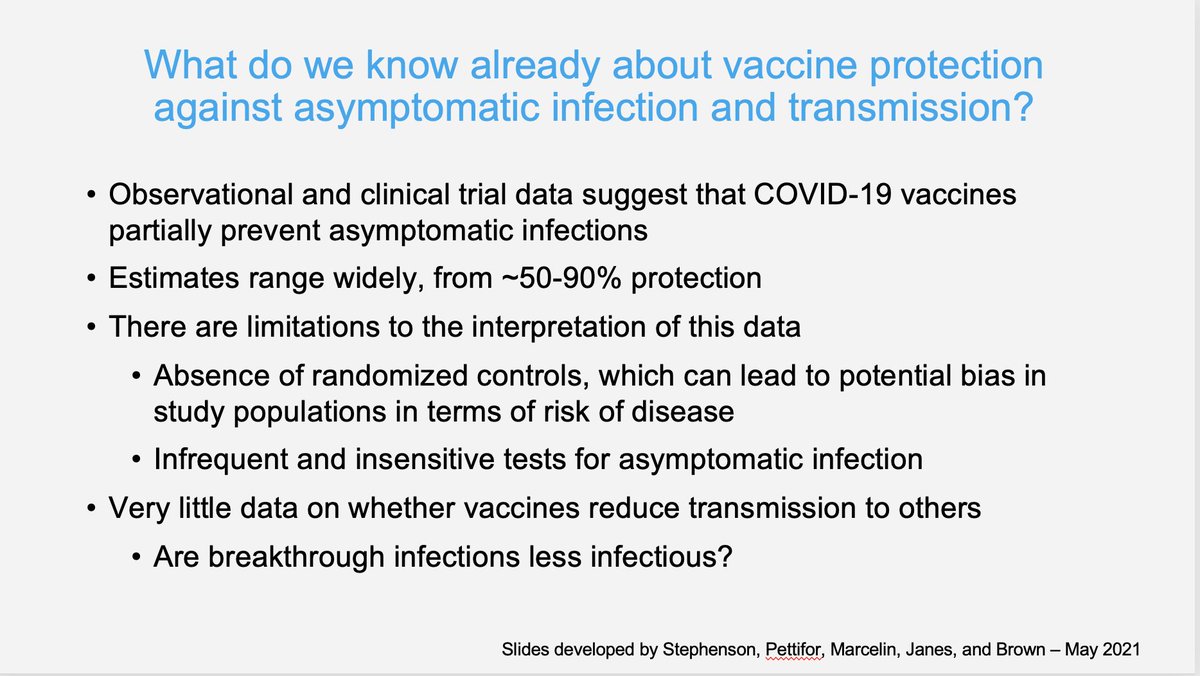
The recent change in @CDCgov policy regarding masking has prompted a lot of people to ask: do #COVID19 #vaccines block transmission of the virus to others? Here is a 🧵using slides my colleagues and I put together recently.

@k_stephensonMD


The recent change in @CDCgov policy regarding masking has prompted a lot of people to ask: do #COVID19 #vaccines block transmission of the virus to others? Here is a 🧵using slides my colleagues and I put together recently. @DrJRMarcelin @ElizabethRBrow2
Slides made by me (Harvard), Audrey Pettifor (UNC), Jasmine Marcelin (UNMC), and Holly Janes and Elizabeth Brown at the Hutch.Image
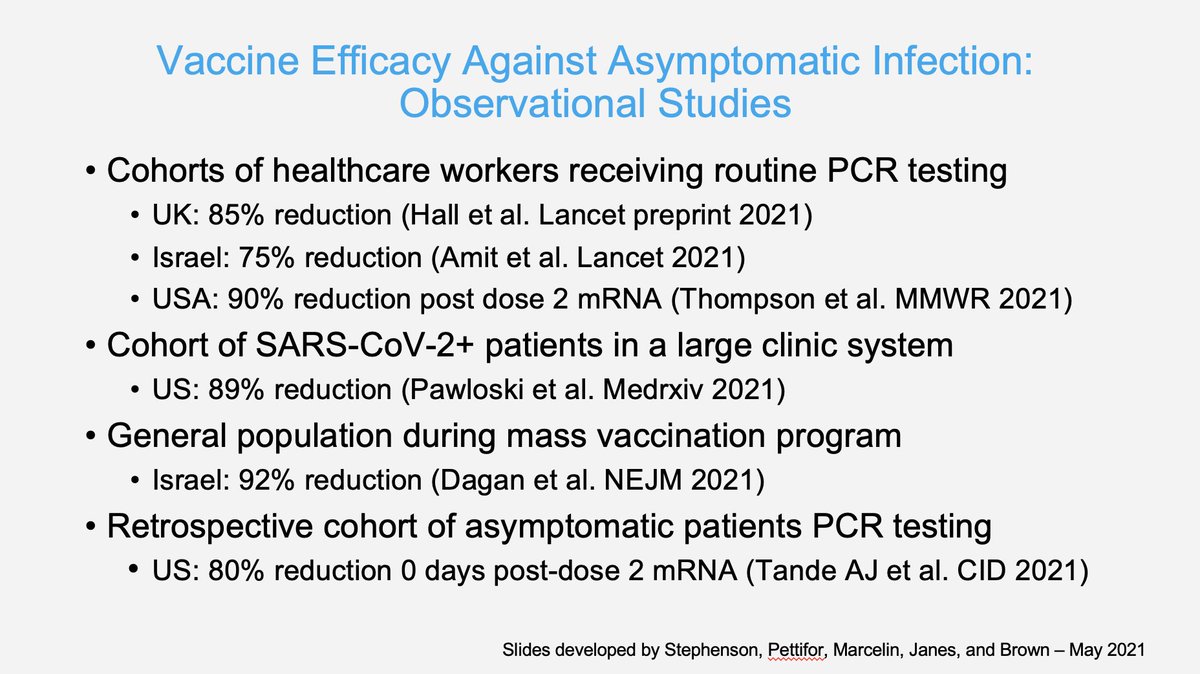
It seems like there is new data every day, so apologies if our slides are already missing something. But here is a summary of some good observational studies on the topic.Image
Same with the trial data - constantly evolving. Here's a sample. VE means vaccine efficacyImage
Image
This question comes up a lot - a little data showing that asymptomatic infections can have a decent amount of viral sheddingImage
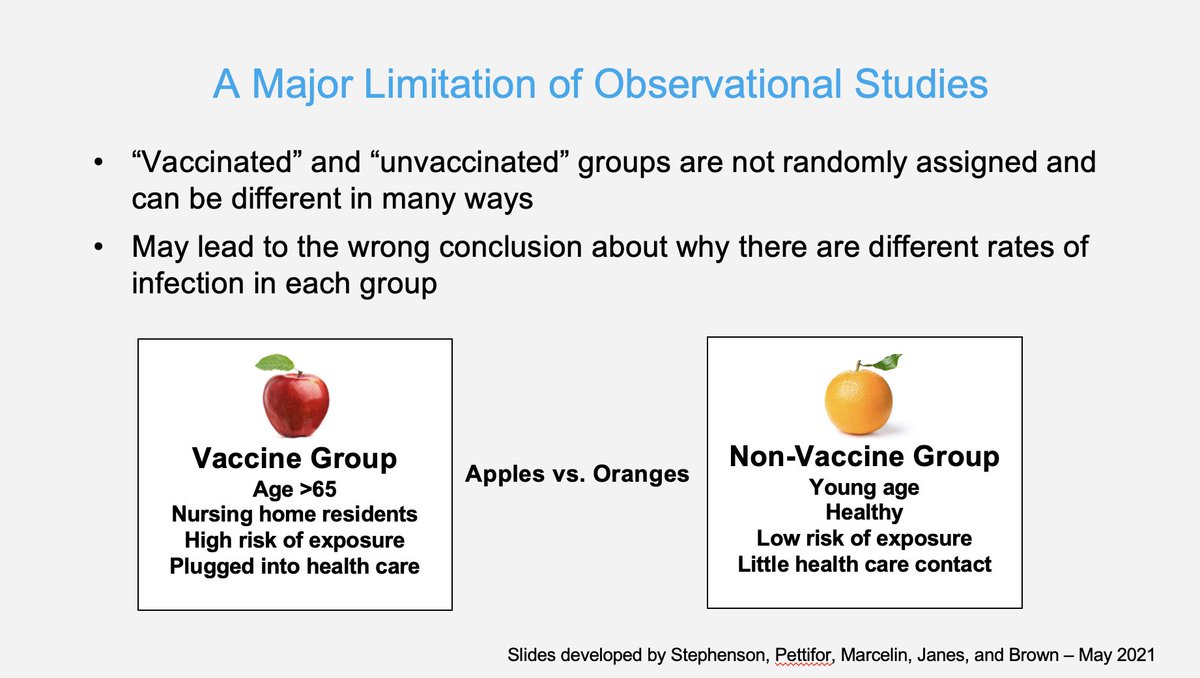
Might be simple for some, but it helps to remember how easily observational studies can be misinterpretedImage
Another common mistake in observational studiesImage
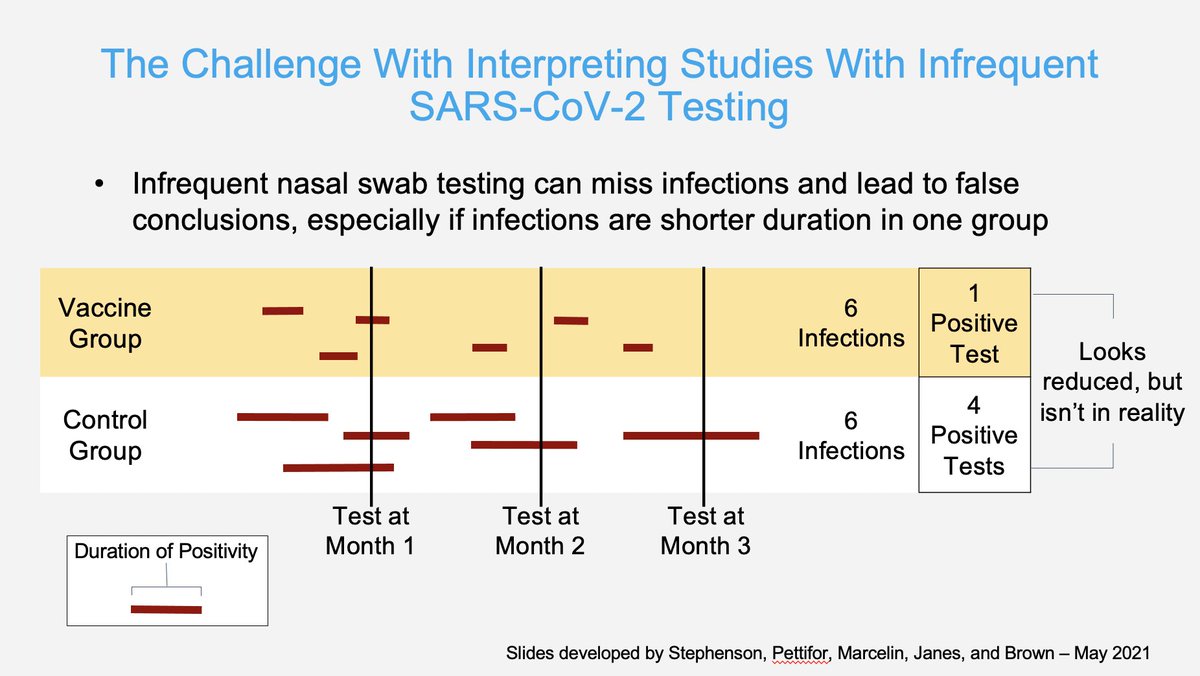
Measuring viral kinetics is extremely challenging - the frequency of testing is a huge factor in accuracyImage
This is may be the most relevant point recently. We still don't know very much about transmission events following breakthrough infections.Image
How is this all relevant to the masking policies? The point here is that we know that vaccines block asymptomatic infection, at least partially. But we don't know a lot about how much forward transmission can occur in the setting of breakthrough infections. 
This data may not always be so important! If everyone is vaccinated, then it's not a big deal. We're all protected against symptomatic disease. And if there's extremely low amounts of virus circulating, it also may not be a big deal. 
When this data really matters is when there is partial vaccination and moderate amounts of circulating virus. That's when we really need to accurately understand the risk of transmission following breakthrough infections. And we don't have that data yet. 

• • •

Tuesday, May 18, 2021

County Council votes to shift more of property tax burden to resident homeowners

Watch Montgomery County Council analyst Gene Smith reveal growing property tax leakage in his May 17 testimony.  His testimony is a little cryptic to those who are not familiar with how property taxes are calculated, but the County Council members understand (or should understand) what's going on.

Mr. Smith explained that the number of properties that have not applied for the Homestead Tax Credit but are receiving the Income Tax Offset Credit (ITOC) is even greater than five years ago. None of the County Council members had questions or expressed concerns about the growing gap. 

Our experience indicates that the most likely causes of the gap between the number of Homestead Tax Credit applications and the number of ITOC credits are failure of new resident homeowners to submit their Homestead Credit Applications and failure of new and existing landlords to advise the State Department of Assessments and Taxation (SDAT) that their investment properties are incorrectly coded as "principal residences". Failure of the state and the county to detect improperly coded investment properties shifts even more of the property tax burden to homeowners who are actually using their properties as their principal residence. 

Data provided by SDAT shows that the amount of tax leakage is likely in the tens of millions of dollars each year.

Start watching at the 3:00 mark.

https://www.youtube.com/watch?v=9kZUDhOfdTY

As explained in testimony by a county resident, Baltimore City has completely eliminated the problem that Mr. Smith revealed by issuing the ITOC only to properties that have an approved Homestead Tax Credit application on file at SDAT.  Even though Baltimore City's solution has been highly successful, Montgomery County refuses to adopt Baltimore City's approach. 

https://www.montgomerycountymd.gov/COUNCIL/Resources/Files/agenda/col/2021/20210504/testimony/item7-LouisWilen.pdf

Study: Md. Public Schools Will Need to Spend $818 Million to Cool Classrooms by 2025


As climate change leads to hotter days across the country, the cost of cooling public school buildings grows higher. New research estimates that more than 280 Maryland public schools that did not need air conditioning in 1970 could have to spend $818 million to install new heating and cooling systems by 2025 to keep classrooms at a safe temperature.

These schools may also have to spend an additional $32.8 million every year to operate and maintain the HVAC systems, affecting more than 900,000 students across the state, according to the report from the Center for Climate Integrity, an environmental advocacy group. And those costs are expected to increase as the climate continues to heat up.

Montgomery County Public Schools, the largest school district in the state, faces the highest increased costs... 

https://www.marylandmatters.org/2021/05/15/study-md-public-schools-will-need-to-spend-818-million-to-cool-classrooms-by-2025/

Virus testing strategies, opinions vary widely in US schools


MISSION, Kan. (AP) — Children are having their noses swabbed or saliva sampled at school to test for the coronavirus in cities such as Baltimore, New York and Chicago. In other parts of the U.S., school districts are reluctant to check even students showing signs of illness for COVID-19.


Education and health officials around the country have taken different approaches to testing students and staff members — and widely varying positions or whether to test them at all as more children give up virtual classrooms for in-person learning. Some states have rejected their share of the billions of dollars the Biden administration made available for conducting virus tests in schools...

https://apnews.com/article/coronavirus-pandemic-education-health-082ade974a5c3257b9f7baa35cb9eec2

Monday, May 17, 2021

Breaking: Woodward High School on Old Georgetown Road Demolished. Only old cell tower remains.

Charles W. Woodward High School (also used as Tilden Middle School) on Old Georgetown Road in Rockville, MD has been demolished.  

As of May 16, 2021, the Woodward High School site:


Only the old cell tower remains standing on the site. 
Pictures taken by Paula Bienenfeld.

Man working on a project for an MCPS contractor at the time sentenced to 15 years in prison for raping 12-year-old girl in his vehicle


A man accused of raping a 12-year-old girl in his vehicle nearly two years ago was sentenced to 15 years in prison on Thursday.

James Allen Booker, now 61, picked up a girl who was walking home from school during a thunderstorm on May 23, 2019, police said at the time.

Police said Booker drove the girl to her home, parked in front and raped the girl inside the vehicle.

The girl told her parents what had happened. Police arrested Booker five days later.

Booker was charged with one count of second-degree rape and six counts of third-degree sex offense. Court records indicate that he pleaded guilty on Dec. 6, 2019, to the rape charge and one count of third-degree sex offense...

https://bethesdamagazine.com/bethesda-beat/courts/man-sentenced-to-15-years-in-prison-for-raping-12-year-old-girl-in-his-vehicle/